AI voice agents are quickly becoming a practical part of modern healthcare operations in Canada. From small family clinics to multi-location dental practices, many providers are exploring voice AI Canadian clinics solutions to reduce front-desk workload, improve patient experience, and handle after-hours calls more efficiently.
But one question comes up again and again: how much does an AI voice agent actually cost in Canada, and is it worth it for a clinic?
This guide breaks down real-world pricing, what influences cost, typical use cases in healthcare voice AI, and what clinics should expect before adopting a clinic AI receptionist.
What is a Voice AI Agent in a Clinic?
A voice AI agent is an automated system that can answer phone calls, understand spoken language, and respond naturally—often acting as a digital receptionist.
In healthcare settings, these systems are used for:
- Appointment booking and rescheduling
- Answering clinic hours and location questions
- Handling prescription refill requests
- Triage-style routing (urgent vs non-urgent calls)
- Sending reminders and confirmations
- Managing after-hours calls
In dental AI voice and medical AI environments, these systems are often integrated with scheduling software and patient management systems to reduce administrative load.
Why Canadian Clinics Are Adopting Voice AI
Healthcare providers in Canada face a unique combination of challenges:
- High patient call volumes during peak hours
- Limited administrative staff
- Rising labour costs
- Missed calls leading to lost appointments
- Burnout among front-desk staff
A clinic AI receptionist helps reduce these pressures by handling repetitive tasks and ensuring no call goes unanswered.
For many clinics, the value is not just automation—it’s consistency. AI systems don’t miss calls, don’t take breaks, and can operate 24/7.
Cost of AI Voice Agents in Canada
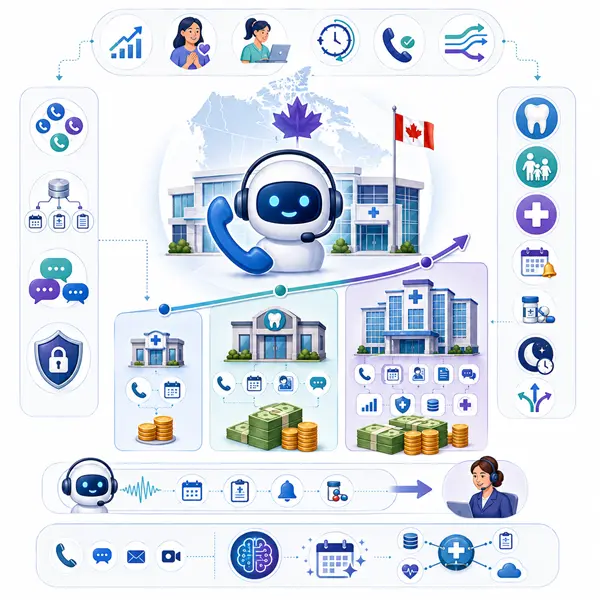
The cost of voice AI Canadian clinics solutions varies widely depending on complexity, integrations, and usage volume. Generally, pricing falls into three categories:
1. Basic AI Voice Receptionist (Small Clinics)
Typical cost:
- Setup: CAD $500 – $2,500
- Monthly subscription: CAD $100 – $500
Best for:
- Small family clinics
- Solo dental practices
- Walk-in clinics with low-to-medium call volume
Features usually include:
- Call answering
- Basic appointment booking
- FAQ responses (hours, location, services)
- Call forwarding to human staff
This is the most affordable entry point into healthcare voice AI.
2. Mid-Level Healthcare Voice AI Systems
Typical cost:
- Setup: CAD $2,500 – $10,000
- Monthly subscription: CAD $500 – $2,000
Best for:
- Multi-doctor clinics
- Dental chains
- Physiotherapy and specialty clinics
Features include:
- EMR/EHR integration
- Advanced scheduling logic
- Multi-language support (important in Canada)
- SMS/email follow-ups
- Patient intake forms via voice
This tier is the most common among growing medical AI users in Canada.
3. Enterprise-Level AI Voice Platforms
Typical cost:
- Setup: CAD $10,000 – $50,000+
- Monthly: CAD $2,000 – $10,000+
Best for:
- Hospital departments
- Large healthcare networks
- Insurance-linked healthcare systems
Features:
- Full automation workflows
- Deep integration with hospital systems
- AI-driven patient triage
- Analytics dashboards
- High compliance and data governance layers
These systems are highly customized and often built specifically for the organization.
What Impacts the Cost of Clinic AI Receptionist Systems?
Several factors influence pricing beyond the base package.
1. Call Volume
The more calls your clinic receives, the higher the cost. Most providers charge based on:
- Per-minute usage
- Monthly call limits
- Concurrent call handling
A busy dental clinic in Toronto will pay significantly more than a small rural practice.
2. Integration Requirements
Costs increase when connecting AI with:
- Electronic Medical Records (EMR)
- Dental management software
- CRM systems
- Online booking platforms
The deeper the integration, the higher the setup cost.
3. Custom Medical Workflows
Healthcare voice AI often requires customization such as:
- Symptom-based routing
- Insurance verification prompts
- Clinic-specific appointment logic
Custom workflows require more development time.
4. Language and Accent Support
In Canada, bilingual support (English and French) is often required. Adding multilingual capabilities increases both setup and training costs.
5. Compliance and Data Security
Healthcare systems must comply with Canadian privacy standards such as PIPEDA.
Security features like:
- Encrypted call handling
- Secure data storage
- Audit logs
can add to overall pricing but are essential in medical environments.
ROI: Is AI Voice Worth It for Clinics?
While costs vary, many clinics recover investment quickly.
Here’s where savings typically come from:
Reduced Front Desk Staffing Pressure
One AI system can handle hundreds of routine calls per day, reducing the need for additional reception hires.
Fewer Missed Appointments
AI ensures calls are answered even after hours, reducing lost bookings.
Increased Patient Satisfaction
Patients get instant responses instead of waiting on hold.
Operational Efficiency
Staff can focus on in-person care instead of repetitive phone tasks.
Many Canadian clinics report ROI within 3–9 months depending on call volume.
Real Use Cases in Canadian Healthcare
Dental Clinics
- Appointment scheduling
- Cleaning reminders
- Treatment follow-ups
Family Practices
- New patient intake
- Prescription queries
- Lab result routing
Specialty Clinics
- Referral management
- Insurance pre-screening
- Pre-appointment screening
Challenges Clinics Should Consider
While healthcare voice AI is powerful, it is not perfect.
Common challenges include:
- Misinterpretation of complex medical queries
- Patient preference for human interaction in sensitive cases
- Initial setup time for training workflows
- Integration delays with legacy systems
Successful adoption usually requires a hybrid approach where AI handles routine tasks and staff manage complex cases.
Future of Voice AI in Canadian Healthcare
The future of medical AI in Canada is moving toward:
- Fully autonomous appointment systems
- Predictive scheduling (AI suggests optimal booking times)
- Voice + chat omnichannel systems
- AI-assisted triage before nurse consultation
- Deeper integration with national healthcare systems
As costs continue to decrease, even smaller clinics will be able to adopt advanced voice automation.
Frequently Asked Questions
1. What is the average cost of a clinic AI receptionist in Canada?
Most clinics spend between CAD $100 and $2,000 per month depending on call volume and features. Setup costs can range from a few hundred dollars to over $10,000 for advanced systems.
2. Is AI voice safe for medical use in Canada?
Yes, but it must comply with Canadian privacy laws such as PIPEDA. Clinics should ensure data encryption, secure storage, and compliant vendors.
3. Can AI handle dental and medical appointments fully?
Yes, for standard bookings, cancellations, and reminders. However, complex cases often require human staff intervention.
4. Do patients in Canada accept AI receptionists?
Many patients are comfortable with it for simple tasks like booking or clinic hours. However, sensitive medical discussions are still preferred with human staff.
5. Does AI reduce clinic staff jobs?
Not typically. It usually shifts staff focus from repetitive phone work to patient care and in-clinic support.
6. What happens if the AI doesn’t understand a patient?
Most systems are designed to escalate the call to a human receptionist or leave a callback request.