There is a particular kind of frustration that creeps up on business owners who have been doing things the traditional way.
You hire someone to answer the phones. They get sick. They take holidays. They miss calls because they are helping someone else. You train them thoroughly, and six months later they quit. You start the cycle all over again.
Meanwhile, potential clients are reaching voicemail, hanging up, and calling your competitor down the street, the one who always seems to pick up.
This is not a small business problem. It is a Canadian business problem.
Industries where this problem shows up
- Healthcare in Halifax
- Home services in Calgary
- Law firms in Toronto
The real question CEOs should ask
The question is no longer whether an AI receptionist can handle your calls.
It is how much longer you can afford to operate without one.
Who this playbook is for
- CEOs
- Founders
- Operations leaders
What this guide covers
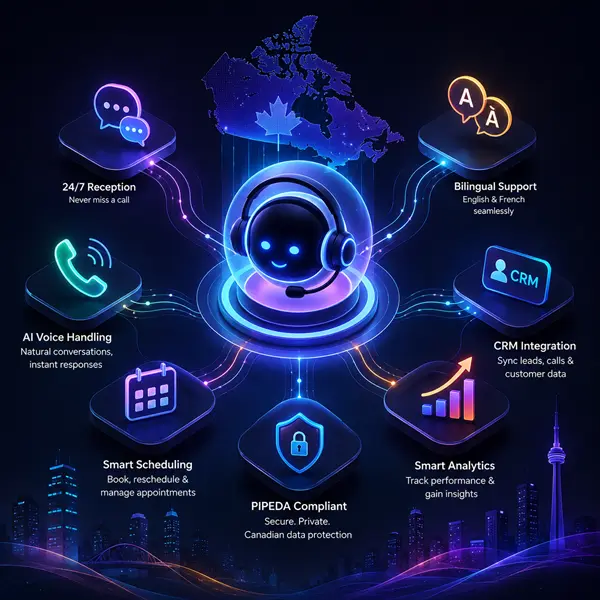
- What AI answering services actually do
- How they fit Canadian business needs
- Cost vs savings breakdown
- How to deploy them properly
Including key Canadian requirements
- PIPEDA compliance
- Bilingual call handling
- CRM integration
The Canadian Business Context Most AI Tools Ignore
Most AI voice systems are built with the United States in mind.
Common US-based assumptions
- Pricing in USD
- HIPAA-focused compliance
- English – Spanish bilingual support
Canada operates differently.
Why Canada is not a smaller version of the US
- Different privacy laws
- Different languages
- Different operational geography
Language reality in Canada
Canada has two official languages: English and French.
In Quebec, Bill 96 enforces strict language requirements.
A proper bilingual system must:
- Hold full conversations in English or French
- Switch languages mid-call without losing context
- Understand Quebec accents and expressions
38% of Montreal callers disconnect if greeted in the wrong language.
PIPEDA and privacy compliance
Caller data includes:
- Names
- Addresses
- Medical or legal concerns
Businesses remain legally responsible under PIPEDA even when using AI vendors.
Key requirements:
- Canadian data storage
- Encryption
- Clear data retention policies
Non-compliance risk: up to CAD $100,000 in penalties
Time zone complexity in Canada
Canada spans six time zones.
Operational challenges include:
- West and East coast communication gaps
- After-hours coverage needs
A 24/7 receptionist is not optional anymore – it is baseline infrastructure.
What an AI Receptionist Actually Does
AI receptionists are not voicemail systems.
They are conversational systems powered by NLP and large language models.
Performance expectations
- Sub-510 millisecond response time
- 85 – 95% of callers believe they are speaking to a human
Core capabilities
- Booking and rescheduling appointments
- CRM integration (HubSpot, Salesforce, Zoho)
- SMS confirmations and intake forms
- Lead capture and qualification
- Handling multiple calls simultaneously
- Smart escalation to human staff
What AI does not handle well
- Emotionally sensitive conversations
- Medical or legal complexity
- Emergency situations
Recommended operating model:
- AI handles 70 – 80% of routine calls
- Humans handle edge cases
Business Case in Canadian Dollars
Cost of a human receptionist
- CAD $3,000 – $4,500 per month in cities
- Around CAD $35,000 per year minimum
Cost of AI receptionist
- CAD $59 – $269 per month typical
- Rarely above CAD $500 per month
Cost comparison
- Human: $36,000 – $54,000 per year
- AI: $700 – $6,000 per year
Revenue Impact of Missed Calls
Key research insights
- 42% of SMBs lose $500+ per month from missed calls
- 96% of customers choose the fastest responder
Real-world examples
- Law firm: $20,000/month lost from missed calls
- Dental clinic: +60% intake growth ($1.7M revenue increase)
- Montreal studio: +65% booking increase
- Home services: more after-hours emergency conversions
Industry Use Cases
Healthcare
AI handles:
- Appointments
- Cancellations
- FAQs
- Intake processes
Key benefits:
- PIPEDA-compliant handling
- Reduced no-shows
- More time for clinical staff
Legal services
AI handles:
- Lead screening
- Consultation booking
- Practice-area routing
Fast response often determines client acquisition.
Trades and home services
AI handles:
- After-hours calls
- Job capture
- Instant owner notifications
Real estate
AI handles:
- Buyer and seller inquiries
- Lead qualification
- Callback scheduling
Speed directly affects conversion rates.
Choosing the Right AI Receptionist
1. PIPEDA compliance
Check:
- Where data is stored
- Retention policies
- Legal compliance handling
2. Bilingual capability
Test for:
- French fluency
- Mid-call switching
- Quebec understanding
3. Integrations
Must support:
- CRM systems
- Calendar tools
- Scheduling platforms
Pricing model
- Prefer flat-rate unlimited usage
- Avoid per-minute billing
5. Setup speed
- 48 – 72 hour deployment
- Minimal technical setup required
Competitive Landscape
Market shift
- 24/7 answering is becoming standard
- AI adoption is accelerating across industries
Market growth
- AI receptionist market projected: $154.8B by 2034
Frequently Asked Questions
Q1. Can AI replace front desk staff?
Yes – it can handle 70 – 80% of routine calls.
Q2. Will customers know it’s AI?
Most callers cannot tell the difference.
Q3. What happens if AI cannot handle a call?
It escalates to a human instantly with full context.
Q4. Can it handle multiple locations?
Yes – across provinces and time zones.
Q5. How fast can it be deployed?
Typically within 48 – 72 hours.