The role of a receptionist has changed significantly as businesses adopt new technology to improve customer service and reduce operational costs. Today, many companies are comparing an AI receptionist with a traditional human front desk employee to understand which option provides better value.
When evaluating AI vs human receptionist cost, businesses need to look beyond the initial price. Factors such as working hours, customer experience, response speed, scalability, and long-term expenses all play an important role in deciding the right solution.
For Canadian businesses, choosing between an AI receptionist and a human receptionist depends on their customer communication needs, budget, and the level of support required. While human receptionists provide personal interaction and relationship-building, AI solutions offer automation, 24/7 availability, and predictable monthly costs.
This guide compares the costs, advantages, and limitations of both options to help businesses make an informed decision.
Understanding the Cost of a Human Receptionist
A human receptionist has traditionally been the standard choice for businesses that need someone to manage calls, greet visitors, schedule appointments, and handle customer inquiries.
However, hiring a full-time employee involves more than just paying a salary. Businesses must consider several expenses, including:
- Salary and wages
- Employee benefits
- Training costs
- Paid holidays and sick leave
- Workplace equipment
- Recruitment expenses
- Office space requirements
The overall receptionist cost Canada businesses experience can vary depending on location, industry, experience level, and employment arrangement.
For a full-time receptionist, businesses often need to budget for ongoing employment expenses beyond the basic wage. This makes human receptionists a larger long-term investment, especially for small businesses with limited administrative budgets.
What Is the Average Receptionist Cost in Canada?
The cost of hiring a receptionist in Canada depends on several factors, including whether the employee works full-time, part-time, remotely, or through an outsourcing provider.
A traditional receptionist may require:
Salary Expenses
A full-time receptionist receives regular wages, which become a fixed monthly business expense. Higher salaries may be required for experienced professionals who manage advanced administrative tasks or customer relationship responsibilities.
Employee Benefits
Many businesses also provide benefits such as:
- Health coverage
- Retirement contributions
- Paid vacation
- Paid personal leave
These additional expenses increase the overall cost of maintaining an in-house receptionist.
Operational Costs
Businesses may also need to provide:
- A dedicated workspace
- Computer systems
- Phone equipment
- Software access
- Training resources
When calculating the true receptionist cost Canada companies pay, these additional factors should be included rather than focusing only on hourly wages.
Understanding AI Receptionist Costs
An AI receptionist uses artificial intelligence technology to handle customer communication tasks such as answering calls, responding to common questions, booking appointments, and collecting customer information.
Unlike a human employee, AI receptionists do not require traditional employment expenses. Businesses usually pay a monthly subscription or service fee based on features, usage, and support requirements.
The AI staffing cost is often easier for businesses to predict because it typically involves a fixed monthly investment rather than salary-related expenses.
Common AI receptionist expenses may include:
- Monthly software subscription
- Setup and integration costs
- Customization fees
- Additional usage charges depending on the provider
The exact cost depends on the technology provider and the level of automation required.
AI vs Human Receptionist Cost: Key Differences
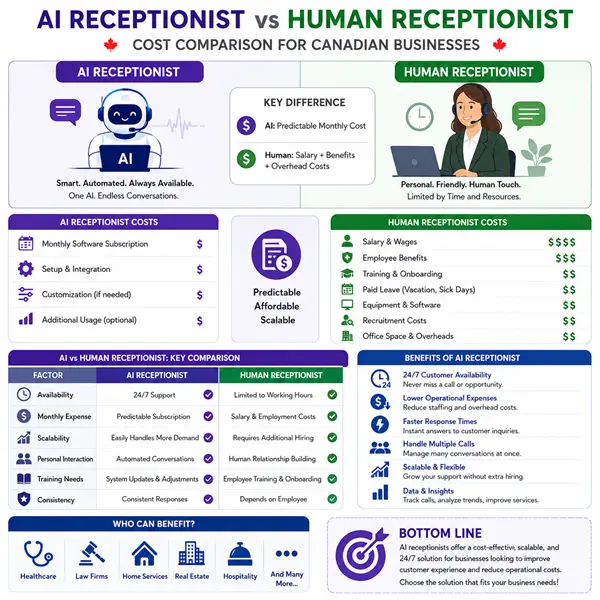
When comparing AI vs human receptionist cost, businesses should consider more than the monthly payment. The biggest differences often involve availability, scalability, and operational flexibility.
| Factor | AI Receptionist | Human Receptionist |
| Availability | 24/7 support capability | Limited to working hours |
| Monthly expense | Predictable subscription cost | Salary and employment expenses |
| Scalability | Can handle increased demand easily | Requires additional hiring |
| Personal interaction | Automated conversations | Human relationship building |
| Training needs | System updates and adjustments | Employee onboarding and training |
| Consistency | Provides consistent responses | Depends on employee availability |
Both options have different strengths, and the right choice depends on business priorities.
Comparing Virtual Receptionist Prices
Many businesses consider outsourced solutions when they do not want to hire a full-time employee. A virtual receptionist combines remote human support with flexible service plans.
The virtual receptionist price varies depending on:
- Number of calls handled
- Service hours
- Appointment booking requirements
- Industry needs
- Additional administrative support
Virtual receptionists can be useful for businesses that want human interaction without the cost of hiring someone internally.
However, compared with AI solutions, virtual receptionist services may still involve higher costs because they depend on human labor.
Benefits of Choosing an AI Receptionist
AI receptionists are becoming popular among businesses because they provide several operational advantages.
24/7 Customer Availability
Customers often contact businesses outside traditional office hours. An AI receptionist can respond immediately, helping businesses capture inquiries even when employees are unavailable.
Lower Operational Expenses
One of the biggest advantages of AI solutions is reducing ongoing staffing expenses. Businesses can automate routine communication tasks without adding another employee to payroll.
Faster Response Times
Customers expect quick answers. AI receptionists can respond instantly to common questions, reducing waiting times and improving customer experiences.
Easy Scalability
As businesses grow, customer communication demands often increase. AI systems can handle more interactions without requiring additional hiring.
Benefits of Human Receptionists
Although AI technology offers many advantages, human receptionists continue to provide important value.
Personal Customer Relationships
Human receptionists can understand emotions, handle complex conversations, and provide personalized support that technology may not fully replace.
Handling Complex Requests
Some situations require problem-solving, empathy, and decision-making. Human employees can manage sensitive customer interactions more naturally.
Brand Representation
A receptionist often becomes the first point of contact between a customer and a business. A skilled employee can create a positive impression and strengthen customer relationships.
Which Option Is Better for Canadian Businesses?
The best choice depends on the type of business and its communication requirements.
An AI receptionist may be suitable for businesses that:
- Receive many repetitive inquiries
- Need after-hours customer support
- Want predictable monthly expenses
- Need appointment scheduling automation
- Want to reduce administrative workload
A human receptionist may be better for businesses that:
- Require personal customer interactions
- Handle complex client needs
- Depend heavily on relationship-building
- Receive fewer but more detailed inquiries
Some businesses may benefit from combining both solutions. AI can manage routine tasks while human employees focus on higher-value customer interactions.
Factors to Consider Before Choosing a Receptionist Solution
Before deciding between AI and human support, businesses should evaluate:
Business Budget
Understanding the long-term financial impact is essential. Compare not only monthly costs but also employee benefits, equipment, training, and scalability.
Customer Expectations
Consider what customers expect when contacting your business. Some industries may require personal communication, while others can successfully use automated support.
Workload and Call Volume
Businesses with high call volumes may find automation more efficient, while companies with fewer complex inquiries may prefer human support.
Future Growth Plans
A solution that works today should also support future business growth. AI systems can often scale quickly without increasing staffing expenses.
Conclusion
Choosing between an AI receptionist and a human receptionist requires businesses to consider cost, customer expectations, and long-term goals. When comparing AI vs human receptionist cost, there is no single solution that works for every company.
Human receptionists provide personal interaction and relationship-building, while AI receptionists offer automation, availability, and predictable expenses. Many Canadian businesses are finding value in using AI to manage routine communication while allowing human teams to focus on more complex customer needs.
Understanding your business requirements, customer expectations, and budget will help you choose the right receptionist solution for sustainable growth.
Frequently Asked Questions
1. Is an AI receptionist cheaper than a human receptionist?
In many cases, an AI receptionist can have lower ongoing costs because it does not involve salary, benefits, or employee-related expenses. However, the best choice depends on business needs and customer service requirements.
2. What factors affect the receptionist cost Canada businesses pay?
The cost depends on salary rates, employee benefits, location, experience level, and whether the receptionist is full-time, part-time, or outsourced.
3. How much does a virtual receptionist cost?
The virtual receptionist price depends on factors such as call volume, service hours, and the level of support required. Different providers offer different pricing structures.
4. Can AI receptionists replace human employees completely?
AI receptionists can handle many routine tasks, but human employees remain valuable for complex conversations, emotional support, and relationship-based customer service.
5. What is included in AI staffing costs?
The AI staffing cost may include software subscriptions, setup, integrations, and ongoing service fees depending on the provider.