
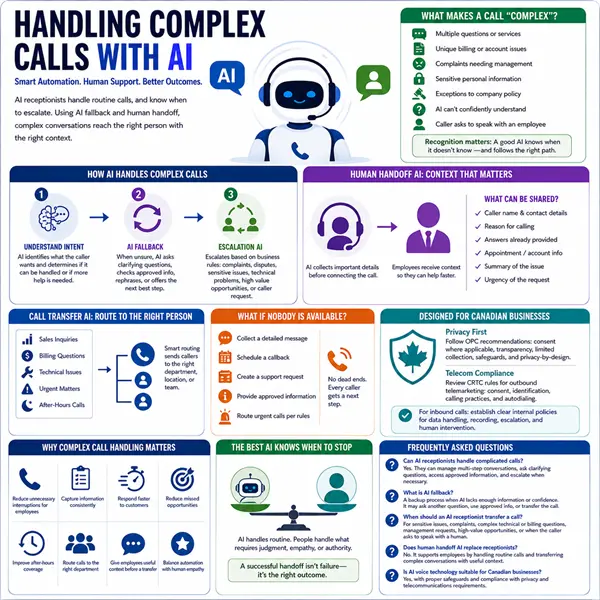
An AI receptionist can answer calls, schedule appointments, collect information, and handle routine customer questions. But what happens when a caller has a complicated request that falls outside the usual script?
This is where a well-designed complex calls AI receptionist becomes valuable. Instead of forcing every caller through the same automated process, modern AI receptionists can recognize when a conversation requires additional support, use an AI fallback when information is unclear, and connect the caller with the right person through human handoff AI.
For Canadian businesses, this approach creates a practical balance between automation and human service. The goal is not to replace people completely. It is to make sure simple calls are handled efficiently while complex conversations reach a human when they need one.
What Makes a Call “Complex”?
Not every customer call can be answered with a simple FAQ. Complex calls usually involve multiple questions, exceptions, sensitive information, or decisions that require human judgment.
Examples include:
- A customer asking about several services at once
- A caller with a unique billing or account issue
- A complaint that requires management attention
- A request involving sensitive personal information
- A customer asking for an exception to company policy
- A situation where the AI cannot confidently understand the caller
- A caller who specifically asks to speak with an employee
A capable AI receptionist should recognize these situations instead of pretending it has an answer.
Why Recognition Matters
The biggest risk with AI phone systems is not that they cannot answer every question. It is when they confidently provide an incorrect answer.
A strong system should be designed to identify uncertainty and follow a predefined escalation path. This makes the conversation feel more natural and protects both the customer and the business.
How AI Handles Complex Calls
A sophisticated AI receptionist can use several layers of support before transferring a call.
1. Understanding the Caller’s Intent
The AI first listens to the conversation and identifies what the caller is trying to accomplish.
For example, someone may call a dental clinic asking about an appointment but then mention insurance, treatment costs, and an urgent dental problem. Rather than treating the conversation as a simple booking request, the AI can recognize that multiple issues are involved.
This allows it to determine whether it can continue independently or whether another team member should become involved.
2. Using AI Fallback
An AI fallback is a safety mechanism for situations where the receptionist does not have enough information to respond confidently.
Instead of guessing, the AI can:
- Ask a clarifying question
- Check approved business information
- Rephrase the caller’s request
- Offer the available next step
- Escalate the conversation when necessary
This creates a more reliable customer experience because uncertainty becomes a reason to investigate or escalate, not invent an answer.
3. Escalation AI
Escalation AI helps determine when a call should move beyond automation.
Businesses can create rules based on specific situations. For example, an AI receptionist may be instructed to escalate:
- Complaints or angry callers
- Payment disputes
- Legal or sensitive questions
- Technical problems outside its knowledge
- High-value sales opportunities
- Requests involving management
- Any situation where the caller asks for a human
This approach allows businesses to automate routine conversations while keeping human employees involved where their expertise matters most.
Human Handoff AI: When a Person Needs to Step In
A good AI receptionist should make transferring a call easy and purposeful.
With human handoff AI, the system can collect important details before connecting the caller to an employee. Instead of saying, “Let me transfer you,” and leaving the employee to start from scratch, the AI can provide useful context.
What Can Be Shared During a Handoff?
Depending on the system and business requirements, the employee may receive:
- Caller name and contact details
- Reason for calling
- Relevant answers already provided
- Appointment or account information
- Summary of the issue
- Urgency of the request
This can reduce repetition and help employees begin the conversation with context.
Call Transfer AI Makes Escalation Smoother
Call transfer AI can route callers based on predefined business rules.
For example:
- Sales inquiries can go to the sales team.
- Billing questions can reach accounts staff.
- Technical issues can go to support.
- Urgent matters can be directed to an appropriate employee.
- After-hours calls can be routed according to an emergency procedure.
This is especially useful for Canadian businesses with multiple locations, departments, or service teams.
What If Nobody Is Available?
Complex calls do not always happen during business hours. A strong AI system should have a fallback plan for unavailable employees.
It could:
- Collect a detailed message
- Schedule a callback
- Create a support request
- Provide approved information
- Route urgent calls according to business rules
This prevents callers from reaching a dead end simply because nobody is available.
Designing AI Receptionists for Canadian Businesses
Canadian businesses should also consider privacy, transparency, and telecommunications requirements when implementing AI voice technology.
The Office of the Privacy Commissioner of Canada recommends privacy safeguards, meaningful consent where applicable, transparency around AI use, limiting personal information collection, and privacy-by-design practices.
Businesses using AI for outbound telemarketing should also review applicable CRTC rules. The CRTC regulates unsolicited telecommunications, including requirements around consent, identification, calling practices, and automatic dialing technologies.
For inbound customer-service calls, businesses should still establish clear internal policies for data handling, recording, escalation, and human intervention.
Why Complex Call Handling Matters
The value of AI is not simply answering more calls. It is handling each call appropriately.
A well-designed system can help businesses:
- Reduce unnecessary interruptions for employees
- Capture information consistently
- Respond faster to customers
- Reduce missed opportunities
- Improve after-hours coverage
- Route calls to the right department
- Give employees useful context before a transfer
Most importantly, it creates a hybrid experience where AI handles what it does well and people handle what requires judgment, empathy, or authority.
The Future of AI Receptionist Support
AI receptionists are becoming more capable, but the strongest systems are not built around the idea that AI must handle everything alone.
The better approach is collaborative. AI manages routine requests, identifies customer intent, uses fallback options when needed, and knows when to involve a person.
The Best AI Knows When to Stop
A reliable complex calls AI receptionist should never view human intervention as failure. A successful handoff can actually be the correct outcome.
When AI fallback, escalation AI, human handoff AI, and call transfer AI work together, businesses can provide faster service without removing the human element from important conversations.
Frequently Asked Questions
Can AI receptionists handle complicated customer calls?
Yes. Modern AI receptionists can manage multi-step conversations, ask clarifying questions, access approved information, and escalate calls when they cannot confidently complete the request.
What is AI fallback?
AI fallback is a backup process used when an AI receptionist does not have enough information or confidence to answer a caller correctly. It may ask another question, use an approved information source, or transfer the call.
When should an AI receptionist transfer a call?
Transfers are appropriate for sensitive issues, complaints, complex technical or billing questions, management requests, high-value opportunities, or situations where the caller specifically wants a human.
Does human handoff AI replace receptionists?
No. Human handoff AI is designed to support employees by handling routine calls and transferring more complicated conversations with useful context.
Is AI voice technology suitable for Canadian businesses?
Yes, but businesses should consider applicable privacy and telecommunications requirements, particularly when collecting personal information or making outbound calls. Appropriate safeguards and clear operating policies should be established before deployment.