
For businesses in Quebec, answering the phone is about more than simply picking up a call. Customers expect clear communication, quick responses, and service in the language they are comfortable using. For many businesses, that means being ready to communicate in both French and English.
This is where a bilingual AI receptionist in Quebec can make a practical difference. Instead of relying entirely on a busy front-desk team, businesses can use AI to answer calls, handle routine questions, collect information, and help customers schedule appointments in French or English.
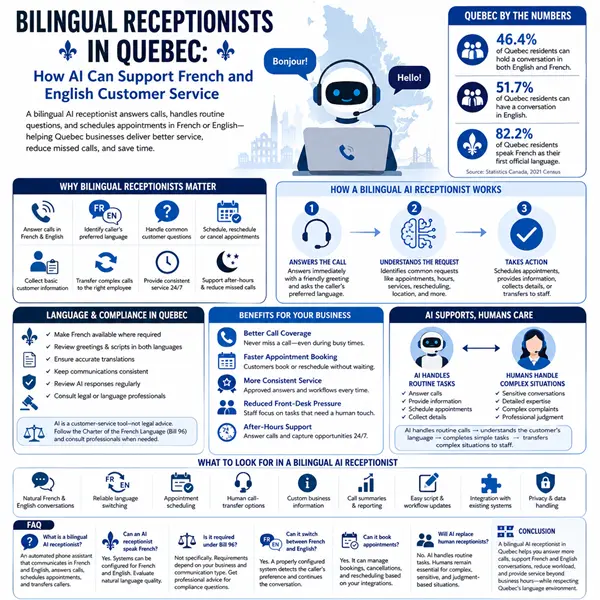
Quebec has a particularly strong need for bilingual customer service. According to Statistics Canada, 46.4% of Quebec residents could hold a conversation in both English and French in 2021. More than half, or 51.7%, could have a conversation in English.
For businesses serving diverse customers, offering a smooth language experience can therefore be both a customer-service advantage and an important operational consideration.
Why Bilingual Receptionists Matter in Quebec
Language can shape the entire customer experience. A caller who struggles to explain their needs or understand an appointment process may become frustrated before they even speak with a staff member.
A bilingual receptionist can help businesses:
- Answer calls in French and English
- Identify the caller’s preferred language
- Handle common customer questions
- Schedule, reschedule, or cancel appointments
- Collect basic customer information
- Transfer complex calls to the appropriate employee
- Provide consistent service outside normal business hours
A Quebec receptionist AI can perform many of these routine tasks without requiring a staff member to answer every call manually.
French-First Customer Service
French has a central role in Quebec’s business environment. Statistics Canada reports that French was the first official language spoken by 82.2% of Quebec’s population in the 2021 Census.
That makes French-language support especially important for businesses operating in the province.
An AI receptionist can be configured to begin interactions in French and switch to English when the caller requests it. This can create a more natural experience while helping businesses manage call volumes efficiently.
Serving English-Speaking Customers
Providing French-first service does not mean ignoring English-speaking customers.
In 2021, 3,898,980 Quebec residents reported being able to converse in both English and French, representing 46.4% of the provincial population.
A bilingual system allows businesses to serve customers according to their preferred language rather than forcing every caller through the same communication process.
How a Bilingual AI Receptionist Works
A modern AI receptionist can act as the first point of contact for incoming calls.
1. It Answers the Call
Instead of sending callers directly to voicemail when employees are busy, the AI can answer immediately.
It can provide a friendly greeting and determine whether the caller wants to continue in French or English.
2. It Understands the Request
The system can identify common requests such as:
- Booking an appointment
- Asking about opening hours
- Requesting basic service information
- Rescheduling an existing appointment
- Asking about location or availability
- Speaking with a particular department
This reduces repetitive work for reception staff.
3. It Takes Appropriate Action
Depending on how the system is configured, it can schedule appointments, collect contact information, provide approved information, or transfer the caller to a human employee.
More complicated requests can still be handled by staff members.
Bilingual AI and Quebec’s Language Requirements
Businesses operating in Quebec should understand their responsibilities under the Charter of the French Language, including changes introduced through Bill 96. Language requirements can vary depending on the type of business, communication, document, or service involved.
An AI receptionist should therefore be treated as a customer-service technology, not as a substitute for legal or regulatory advice.
What Businesses Should Consider
When implementing a Bill 96 receptionist solution, businesses should:
- Make French available for customer interactions where required
- Review automated greetings and scripts in both languages
- Ensure important information is accurately translated
- Keep customer-facing communications consistent with applicable requirements
- Review AI responses regularly for accuracy and appropriateness
- Consult qualified legal or language professionals when compliance questions arise
Quebec provides an official process for reporting alleged breaches of the Charter of the French Language through the Office québécois de la langue française.
The goal should be to combine technology with a thoughtful language strategy rather than assuming that simply adding an AI tool automatically creates compliance.
Benefits for Quebec Businesses
A bilingual AI receptionist can provide several practical advantages.
Better Call Coverage
Calls can be answered even when employees are helping customers, attending meetings, or dealing with other responsibilities.
Faster Appointment Booking
Customers can complete routine booking requests without waiting for someone at the front desk.
More Consistent Service
A well-configured system can use approved greetings, answers, and workflows across every call.
Reduced Front-Desk Pressure
Employees can spend less time answering repetitive questions and more time handling tasks that require human attention.
After-Hours Support
A bilingual AI receptionist can continue answering calls outside regular business hours, helping reduce missed opportunities.
What AI Cannot Replace
AI receptionists are designed to support human teams, not eliminate the need for them.
Some situations require empathy, professional judgment, or detailed expertise. For example, a customer with a complicated complaint may need to speak directly with an employee.
A strong setup should therefore create a clear path from AI to human support.
The Best Approach
The most effective model is often:
AI handles routine calls → understands the customer’s language → completes simple tasks → transfers complex situations to staff.
This creates a balance between automation and personal service.
Choosing a Bilingual AI Receptionist in Quebec
Before choosing a system, businesses should evaluate more than whether it can speak two languages.
Look for:
- Natural French and English conversations
- Reliable language switching
- Appointment scheduling capabilities
- Human call-transfer options
- Custom business information
- Call summaries and reporting
- Integration with existing systems
- Clear privacy and data-handling practices
- Easy script and workflow updates
The quality of the French experience is particularly important. A system should sound natural and understand common conversational variations rather than simply translating English word-for-word.
The Future of Bilingual Customer Service
As businesses continue adopting automation, AI receptionists are likely to become a more common part of front-desk operations. Quebec is a particularly relevant market because businesses often need to balance French-language service with the needs of English-speaking customers.
A French receptionist powered by AI can provide immediate, consistent assistance while allowing human employees to focus on more valuable conversations.
The technology works best when it is thoughtfully configured around the business, its customers, and Quebec’s language environment.
Conclusion
For Quebec businesses, bilingual customer service is about meeting customers where they are. A bilingual AI receptionist in Quebec can help businesses answer more calls, support French and English conversations, reduce front-desk workload, and provide service beyond regular business hours.
When implemented carefully, AI can complement human reception teams while creating a faster and more accessible customer experience. The key is to combine reliable technology, natural French communication, strong human handoffs, and a clear understanding of applicable Quebec language requirements.
Frequebtly Asked Questions
What is a bilingual AI receptionist in Quebec?
A bilingual AI receptionist is an automated phone-based assistant that can communicate with customers in French and English. It can answer calls, provide information, schedule appointments, and transfer callers to employees.
Can an AI receptionist speak French?
Yes. AI receptionist systems can be configured to communicate in French and English. However, businesses should evaluate how naturally the system understands and speaks French before deploying it.
Is a bilingual AI receptionist required under Bill 96?
Not specifically. Bill 96 introduced changes to Quebec’s language framework, but whether a business needs particular language services depends on its circumstances and the type of communication involved. Businesses should obtain professional advice for specific compliance questions.
Can AI receptionists switch between French and English?
Yes. A properly configured bilingual system can identify a caller’s preferred language and continue the conversation accordingly.
Can a bilingual AI receptionist book appointments?
Yes. Depending on the technology and integrations available, an AI receptionist can manage appointment scheduling, cancellations, and rescheduling.
Will AI replace human receptionists?
Not necessarily. AI is most useful for routine and repetitive tasks. Human employees remain important for complex questions, sensitive conversations, complaints, and situations requiring judgment.