AI voice agents are rapidly transforming how businesses communicate with customers. From answering inbound calls and booking appointments to qualifying leads and handling customer support, voice AI is becoming an essential business tool across Canada.
However, not all solutions are created equal. With dozens of providers entering the market, businesses often struggle to compare features, pricing models, integrations, and performance capabilities. Choosing the wrong platform can lead to poor customer experiences, integration challenges, and unnecessary costs.
This AI voice agent buyer checklist is designed to help Canadian businesses evaluate vendors and make informed purchasing decisions. Whether you’re a healthcare clinic, law firm, real estate agency, contractor, or enterprise organization, this guide covers the key factors you should assess before investing in Voice AI technology.
By following this AI voice agent buyer checklist, you’ll be better equipped to compare providers, identify must-have features, and select a solution that supports your long-term business goals.
Understanding the Role of AI Voice Agents
What Is an AI Voice Agent?
An AI voice agent is a software-powered virtual assistant that interacts with callers using natural language conversations.
Unlike traditional IVR systems that rely on keypad menus, AI voice agents can:
- Understand spoken requests
- Answer questions
- Book appointments
- Qualify leads
- Transfer calls
- Update business systems
- Provide customer support
Modern Voice AI solutions are becoming increasingly sophisticated and capable of handling complex interactions.
Why Businesses Are Adopting Voice AI
Organizations across Canada are investing in Voice AI because it helps:
- Reduce staffing pressure
- Improve customer response times
- Automate repetitive tasks
- Increase lead capture
- Support after-hours operations
The growing number of voice AI vendors means buyers must carefully evaluate available options.
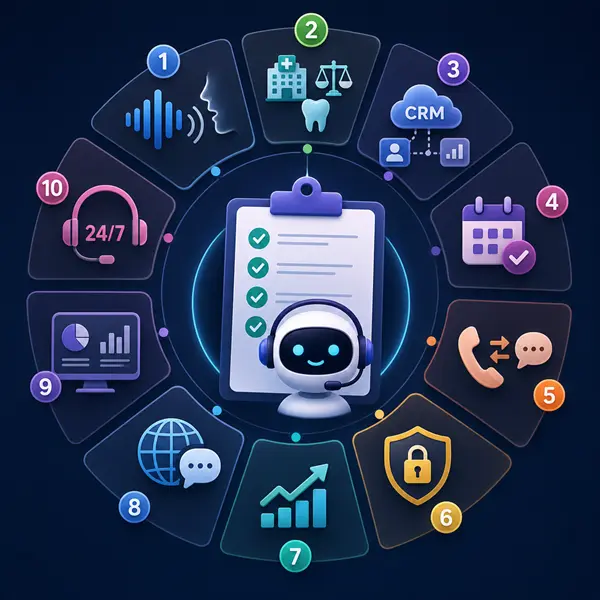
AI Voice Agent Buyer Checklist: Key Evaluation Areas
1. Voice Quality and Natural Conversation
Why It Matters
The first impression callers have of your AI system is often based on how natural it sounds.
Poor-quality voices can frustrate customers and reduce trust.
Questions to Ask
- Does the voice sound human-like?
- Are conversations natural and fluid?
- Can the AI understand different accents?
- Does it manage interruptions effectively?
What to Look For
The best solutions offer:
- Natural speech patterns
- Fast response times
- Context awareness
- Minimal robotic behavior
Voice quality should be at the top of every AI voice agent buyer checklist.
2. Industry-Specific Capabilities
Generic vs Specialized Solutions
Some Voice AI platforms are built for broad use cases, while others target specific industries.
Industry Examples
Healthcare
- Appointment booking
- Patient reminders
- Call routing
Real Estate
- Lead qualification
- Property inquiries
- Appointment scheduling
Legal Services
- Client intake
- Consultation booking
- FAQ handling
Choose a platform aligned with your industry requirements.
3. CRM Integration Capabilities
Why AI Voice CRM Integration Matters
Without integrations, employees may still need to manually update records.
Strong CRM connectivity improves efficiency and accuracy.
Important Integrations
- HubSpot
- Salesforce
- Zoho CRM
- Microsoft Dynamics
- Pipedrive
Businesses evaluating voice AI vendors should prioritize CRM compatibility.
Questions to Ask Vendors
- Does the platform create CRM records automatically?
- Can it update existing contacts?
- Are notes logged after calls?
- Does it trigger workflows?
Strong AI voice comparison efforts should include CRM functionality.
4. Calendar and Scheduling Integrations
The Importance of Automated Scheduling
Appointment booking remains one of the most valuable Voice AI use cases.
Key Calendar Integrations
- Google Calendar
- Microsoft Outlook
- Calendly
- Acuity Scheduling
- Practice management systems
A strong choosing AI voice agent strategy includes reviewing scheduling capabilities carefully.
Essential Features
Look for:
- Real-time availability checks
- Automatic booking
- Appointment reminders
- Rescheduling functionality
These features improve customer experiences while reducing administrative work.
5. Call Handling Capabilities
Evaluate Conversation Performance
Not all Voice AI platforms handle conversations equally.
Important Features
- Call transfers
- Escalation workflows
- Multi-step conversations
- FAQ handling
- Lead qualification
Advanced Capabilities
Leading solutions can:
- Understand caller intent
- Ask follow-up questions
- Personalize responses
- Adapt conversations dynamically
A comprehensive AI voice agent buyer checklist should always assess call handling quality.
6. Security and Privacy Compliance
Why Security Matters
Businesses often handle sensitive customer information.
Canadian organizations must consider privacy requirements and data protection standards.
Important Questions
- Where is data stored?
- Is information encrypted?
- What security certifications exist?
- How is customer data protected?
Canadian Compliance Considerations
Organizations should ensure vendors support the following:
- PIPEDA requirements
- Secure data management
- Access controls
- Audit capabilities
Security should be a major component of any AI voice comparison process.
7. Scalability and Growth Potential
Think Beyond Current Needs
Your business may grow significantly over the next few years.
The Voice AI solution should support:
- Higher call volumes
- Additional departments
- New locations
- Expanded use cases
Questions to Ask
- How many simultaneous calls can be handled?
- Are usage limits flexible?
- Can workflows be expanded easily?
Scalability is a critical consideration when choosing AI voice agent solutions.
8. Multilingual Support
Why Language Capabilities Matter
Canada’s diverse population often requires support beyond English.
Common Requirements
- English
- French
- Additional languages
Businesses serving multilingual customers should evaluate language support carefully.
Important Features
- Accent recognition
- Language switching
- Natural pronunciation
Leading voice AI vendors increasingly offer advanced multilingual capabilities.
9. Analytics and Reporting
Measuring Performance
Data-driven insights help businesses optimize AI performance.
Essential Reporting Features
- Call volume tracking
- Conversion metrics
- Appointment booking rates
- Lead qualification outcomes
- Customer interaction summaries
Why Reporting Matters
Analytics help organizations:
- Improve workflows
- Identify bottlenecks
- Measure ROI
- Enhance customer experiences
Any serious AI voice comparison should evaluate reporting capabilities.
10. Customization and Flexibility
Every business is different.
Voice AI should align with your specific business processes.
Areas for Customization
- Greeting scripts
- Conversation flows
- Escalation rules
- Branding elements
- Scheduling workflows
The best providers allow significant customization without requiring extensive technical expertise.
11. Pricing Structure
Understanding Voice AI Pricing
Pricing models vary significantly among voice AI vendors.
Common Pricing Models
- Monthly subscription
- Usage-based pricing
- Per-minute billing
- Enterprise licensing
Questions to Ask
- What is included in the base package?
- Are integrations included?
- Are there setup fees?
- Are support costs extra?
A complete AI voice agent buyer checklist should always include a detailed pricing analysis.
12. Customer Support and Onboarding
Why Support Matters
Even the best technology requires proper implementation.
Evaluate
- Onboarding assistance
- Technical support availability
- Training resources
- Response time
Strong Vendors Provide
- Dedicated implementation teams
- Documentation
- Ongoing support
- Strategic guidance
Support quality often separates top-tier providers from competitors.
Common Mistakes When Choosing AI Voice Agent Solutions
Focusing Only on Price
Cheaper platforms may lack the following:
- Reliability
- Integrations
- Scalability
- Customer support
Ignoring Future Growth
Businesses often underestimate future requirements.
Choose a solution that supports long-term expansion.
Skipping Real-World Testing
Always request:
- Product demonstrations
- Trial periods
- Sample call scenarios
Testing helps validate vendor claims.
AI Voice Comparison Framework
Quick Vendor Evaluation Checklist
When conducting an AI voice comparison, score providers on:
Voice Quality
- Natural conversation
- Accent recognition
- Responsiveness
Integrations
- CRM compatibility
- Calendar connectivity
- Business software support
Security
- Data protection
- Compliance readiness
- Access controls
Support
- Onboarding
- Technical assistance
- Training resources
Pricing
- Transparency
- Scalability
- Value for money
This framework simplifies the process of choosing AI voice agent platforms.
Conclusion
The Voice AI market is evolving quickly, and businesses have more options than ever before. While this creates exciting opportunities, it also makes vendor selection more complex.
Following a structured AI voice agent buyer checklist helps organizations evaluate solutions based on what truly matters: voice quality, integrations, security, scalability, support, and long-term value.
Whether you’re comparing leading voice AI vendors, conducting an AI voice comparison, or actively choosing AI voice agent technology for your business, taking the time to assess each platform carefully can prevent costly mistakes and maximize your return on investment.
The right Voice AI solution should not only meet your current needs but also support your organization’s growth, customer service goals, and operational efficiency well into 2026 and beyond.
Frequently Asked Questions
1. What is an AI voice agent buyer checklist?
An AI voice agent buyer checklist is a framework used to evaluate Voice AI providers based on features, integrations, pricing, security, and support.
2. Why should businesses compare voice AI vendors?
Different voice AI vendors offer varying levels of performance, integrations, customization, and customer support.
3. What should be included in an AI voice comparison?
An AI voice comparison should evaluate voice quality, CRM integrations, scheduling features, security, analytics, scalability, and pricing.
4. How important are CRM integrations?
CRM integrations are extremely valuable because they automate data entry, improve efficiency, and enhance customer management workflows.
5. What should I look for when choosing AI voice agent solutions?
When choosing AI voice agent platforms, evaluate voice quality, business integrations, security standards, customization options, and customer support.
6. Are Voice AI systems suitable for small businesses?
Yes. Many Voice AI platforms offer flexible pricing and features suitable for small and medium-sized businesses.
7. How can I evaluate Voice AI quality?
Request demos, conduct test calls, review conversation accuracy, and assess how naturally the AI interacts with callers.
8. Do Canadian businesses need to consider privacy regulations?
Yes. Organizations should ensure Voice AI providers support Canadian privacy requirements and secure data-handling practices.