Artificial intelligence has transformed customer communication across Canada. From booking appointments to handling customer support calls, AI voice agents are becoming a valuable business tool.
However, one question remains: How accurate are AI voice agents?
Accuracy is no longer just about recognizing words. Modern voice AI must understand context, identify intent, and complete tasks successfully.
How Voice AI Works
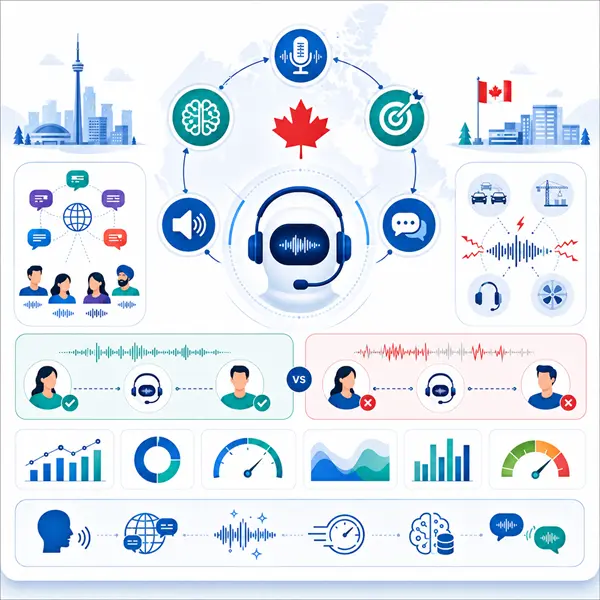
A typical AI voice agent processes conversations through several stages:
1. Speech Recognition (ASR)
Converts spoken words into text.
2. Language Understanding
Interprets the meaning behind the words.
3. Intent Detection
Identifies what the caller wants to achieve.
4. Response Generation
Creates an appropriate reply.
5. Voice Response
Delivers the response naturally to the caller.
The Current State of Voice AI Accuracy
Modern voice AI systems have improved significantly over the last few years. Many platforms now achieve speech recognition accuracy above 90% under ideal conditions.
However, real-world accuracy depends on several factors:
- Audio quality
- Caller accents
- Background noise
- Speaking speed
- Industry terminology
This is why businesses should focus on real-world performance rather than benchmark numbers alone.
What Is ASR and Why Does It Matter?
Understanding Automatic Speech Recognition
Automatic Speech Recognition (ASR) is the technology that converts spoken language into text.
Every AI voice agent relies on ASR to understand callers accurately.
Word Error Rate (WER)
ASR performance is commonly measured using Word Error Rate (WER), which tracks:
- Substitutions
- Insertions
- Deletions
The lower the WER, the higher the speech recognition accuracy.
AI Voice Agent Accuracy for Canadian Businesses
Canada presents unique challenges because businesses serve customers from diverse linguistic and cultural backgrounds.
Common Languages Spoken in Canada
- English
- French
- Punjabi
- Mandarin
- Arabic
- Urdu
- Tagalog
Regional accents can also vary significantly between provinces.
As a result, businesses should evaluate voice AI using conversations that reflect their actual customer base.
How Well Do Voice AI Systems Handle Accents?
One of the biggest concerns surrounding voice AI accuracy is accent recognition.
Modern systems are trained on large multilingual datasets and generally perform well across common Canadian accents.
Challenges That Still Affect Accuracy
- Strong regional dialects
- Rapid speech
- Code-switching between languages
- Local slang
- Poor call quality
Testing with real customer conversations remains essential.
Background Noise and Recognition Performance
Even advanced voice AI systems can struggle in noisy environments.
Common Sources of Noise
- Traffic
- Construction
- Restaurants
- Busy offices
- Wind
- Multiple speakers
The more noise present, the harder it becomes for the AI to separate speech from background sounds.
Why Intent Recognition Matters More Than Speech Recognition
A voice agent can hear every word correctly and still fail if it misunderstands the caller’s goal.
Common Customer Intents
- Booking appointments
- Rescheduling appointments
- Product inquiries
- Billing questions
- Technical support requests
For most businesses, intent recognition accuracy is often more important than perfect transcription.
Why Demo Accuracy Doesn’t Match Real-World Accuracy
Many voice AI demonstrations occur under ideal conditions.
Demo Environments Usually Include
- Clear speakers
- High-quality microphones
- Stable internet connections
- Predictable questions
Real Customer Calls Include
- Interruptions
- Topic changes
- Emotional conversations
- Unexpected requests
- Poor call quality
This is why real-world testing is critical before deployment.
Key Metrics Businesses Should Monitor
Speech Recognition Accuracy
Measures how accurately speech is converted into text.
Intent Recognition Accuracy
Measures how often the AI understands customer goals correctly.
Task Completion Rate
Measures whether customers successfully complete their intended action.
First Contact Resolution
Tracks how often issues are solved during the first interaction.
Escalation Rate
Measures how frequently calls need to be transferred to a human agent.
What Accuracy Level Should Businesses Expect?
Most Canadian businesses can expect strong performance when AI voice agents handle:
- Appointment scheduling
- Customer inquiries
- Lead qualification
- Basic support requests
However, performance may decrease during:
- Complex conversations
- Heavy background noise
- Specialized industry discussions
- Multi-language interactions
The most successful deployments combine AI automation with human support when necessary.
The Future of AI Voice Agent Accuracy
Voice AI technology continues to improve in several key areas:
Emerging Improvements
- Accent recognition
- Multilingual support
- Noise reduction
- Real-time processing
- Context retention
- Long-form conversations
As these technologies advance, voice AI will become even more reliable for Canadian businesses.
Conclusion
Today’s AI voice agents are more accurate than ever before. While factors such as accents, noise, and conversation complexity still affect performance, modern systems can successfully handle many routine customer interactions.
For Canadian businesses, the key is evaluating voice AI in real-world conditions and choosing solutions that balance automation with human support when needed.
Frequently Asked Questions
1. How accurate are AI voice agents?
Most modern systems achieve over 90% accuracy in clear audio conditions.
2. Can AI voice agents understand Canadian accents?
Yes, most modern platforms handle common Canadian accents effectively.
3. What affects voice AI accuracy the most?
Background noise, call quality, accents, speaking speed, and industry-specific terminology.
4. What is ASR?
ASR stands for Automatic Speech Recognition, the technology that converts speech into text.
5. What is Word Error Rate (WER)?
WER measures transcription mistakes. Lower scores indicate better accuracy.
6. Can voice AI work in noisy environments?
Yes, but accuracy typically decreases as noise levels increase.
7. Is voice AI better than traditional IVR?
Generally yes. Voice AI can understand natural language and customer intent.
8. Does voice AI support English and French?
Many modern platforms support both languages, making them ideal for Canadian businesses.
9. Will AI voice agents replace human agents?
No. Most businesses use AI to handle routine tasks while humans manage complex conversations.