
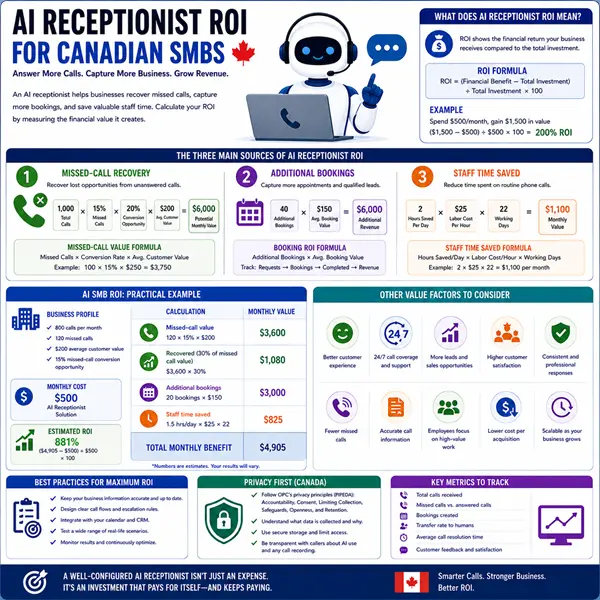
For many small and medium-sized businesses, answering every phone call is harder than it sounds. Employees may be serving customers, attending meetings, working remotely, or simply handling several tasks at once. When a call goes unanswered, the business may lose more than a conversation. It may lose a booking, lead, sales opportunity, or repeat customer.
This is why businesses considering an AI receptionist should look beyond the monthly software cost. The more useful question is, what financial value can the system create or recover?
Calculating AI receptionist ROI does not have to be complicated. Canadian SMBs can estimate the potential return by looking at three practical areas: missed calls recovered, bookings captured, and staff time saved.
This guide explains how to calculate those numbers, which costs to include, and what businesses should measure after implementation.
What Does AI Receptionist ROI Mean?
AI receptionist ROI refers to the financial return a business receives from implementing an AI receptionist compared with the cost of operating the solution.
A simple ROI formula is
ROI = (Financial benefit − Total investment) ÷ Total investment × 100
For example, if a business spends $500 per month on an AI receptionist and generates or saves $1,500 in measurable value, the calculation would be
($1,500 − $500) ÷ $500 × 100 = 200% ROI
The actual result will vary considerably between businesses.
A company receiving hundreds of calls each month may have more opportunities to recover missed business than a company receiving only a handful.
The Three Main Sources of AI Receptionist ROI
A useful receptionist ROI calculation should consider more than direct sales.
There are three main areas to evaluate:
- Missed-call recovery
- Additional bookings or leads
- Staff time saved
Each can contribute to the overall financial value of an AI receptionist.
1. Calculate the Value of Missed Calls
Missed calls are often the easiest starting point.
Imagine a business receives 1,000 calls each month and misses 15% of them.
That means approximately:
1,000 × 15% = 150 missed calls
The next question is how many of those calls could have become customers.
Suppose 20% of missed calls normally represent genuine sales opportunities:
150 × 20% = 30 potential opportunities
If the average value of a completed booking is $200:
30 × $200 = $6,000 potential monthly revenue
This does not mean the business will automatically recover the entire $6,000 with AI. Some callers may not have purchased anyway.
Instead, the calculation provides an estimate of the missed call value that may be available for recovery.
What Is Missed Call Value?
Missed call value represents the potential financial opportunity associated with calls a business fails to answer.
The calculation can be approached like this:
Missed calls × estimated conversion rate × average customer value = potential missed-call value
For example:
- 100 missed calls
- 15% estimated conversion rate
- $250 average customer value
100 × 15% × $250 = $3,750
This gives the business a starting estimate.
The important point is to use realistic historical data wherever possible rather than assuming every missed call represents lost revenue.
2. Measure Additional Bookings
The second major component of AI receptionist ROI is the number of additional bookings or qualified leads captured.
An AI receptionist can respond to incoming inquiries when human staff is unavailable.
For example, a salon might receive calls asking about appointments. If the AI receptionist can schedule approved appointments directly through the business calendar, some callers who might otherwise have waited for a callback can complete their booking immediately.
A simple calculation is
Additional bookings × average booking value = additional revenue
Suppose the system contributes to 40 additional bookings each month and the average booking generates $150:
40 × $150 = $6,000
Again, this should be treated as an estimated contribution rather than automatically attributing every booking to the AI system.
Understanding Booking ROI
Booking ROI focuses specifically on the financial value generated through appointments or reservations captured by the receptionist.
Businesses can track:
- Number of calls
- Number of booking requests
- Completed bookings
- Average booking value
- Cancellation rate
- Lead-to-customer conversion rate
This creates a much clearer picture of whether automated call handling is contributing to actual business outcomes.
For service businesses, booking ROI may be especially useful because an appointment often has a relatively clear monetary value.
3. Calculate Staff Time Saved
Revenue recovery is only one part of the equation.
An AI receptionist can also reduce the amount of time employees spend handling repetitive calls.
Consider a business where an employee spends two hours each day answering routine calls.
If the employee’s effective labor cost is $25 per hour:
2 hours × $25 × 22 working days = $1,100 per month
If automation reduces the administrative workload by half, the business could potentially redirect around $550 worth of staff time each month.
The actual financial benefit depends on what employees do with that recovered time.
If they use it to serve customers, complete billable work, process leads, or perform higher-value tasks, the value can be greater than simply calculating wages saved.
AI SMB ROI: A Practical Example
Let’s look at a hypothetical Canadian small business.
The business receives:
- 800 calls per month
- 120 missed calls
- $200 average customer value
- 15% estimated missed-call conversion opportunity
Potential missed-call value:
120 × 15% × $200 = $3,600
Now assume an AI receptionist helps recover 30% of those opportunities:
$3,600 × 30% = $1,080
The business also estimates $500 in staff time saved each month.
Total estimated monthly value:
$1,080 + $500 = $1,580
If the AI receptionist costs $400 per month:
($1,580 − $400) ÷ $400 × 100 = 295%
This is an example of AI SMB ROI, not a guaranteed result. Actual performance depends on call volume, conversion rates, customer value, staffing costs, and the capabilities of the chosen system.
What Costs Should Be Included?
An accurate ROI calculation should account for the complete investment rather than looking only at the subscription price.
Potential costs include:
Software Fees
This may be a monthly or annual subscription.
Usage Charges
Some providers charge based on call minutes, conversations, or other usage metrics.
Setup Costs
Businesses may need to pay for initial configuration, integrations, or custom workflows.
Integration Costs
Connecting the receptionist with CRM, calendars, booking systems, or other software may involve additional expenses.
Staff Training
Employees may need training to manage escalations and review AI-generated information.
Including these costs produces a more realistic receptionist ROI calculation.
How to Build an AI Receptionist ROI Baseline
Before implementing the system, collect at least 30 days of existing business data.
Track:
- Total inbound calls
- Answered calls
- Missed calls
- Average call duration
- Number of appointments
- Number of qualified leads
- Average customer value
- Staff hours spent answering calls
This baseline provides something to compare against after implementation.
Without baseline data, it can be difficult to determine whether performance has actually improved.
Metrics to Track After Implementation
Once the AI receptionist is active, continue measuring performance.
Call Answer Rate
How many incoming calls are successfully handled?
Booking Conversion
How many eligible calls result in appointments?
Lead Capture
How many qualified inquiries are recorded?
Missed-Call Recovery
How many opportunities that previously would have been missed are now handled?
Staff Time Saved
How much time do employees spend on routine call handling compared with before?
Customer Outcomes
Are customers successfully reaching the business and receiving appropriate assistance?
These metrics provide a broader view than revenue alone.
Don’t Measure ROI on Revenue Alone
A common mistake is assuming that every additional call automatically creates revenue.
Some callers may:
- Ask questions without purchasing
- Compare multiple providers
- Cancel appointments
- Require services the company does not offer
- Call by mistake
For this reason, businesses should distinguish between calls handled, leads captured, bookings made, and completed sales.
The more reliable the data, the more meaningful the ROI calculation becomes.
How Different SMBs Can Calculate Their ROI
Home Service Businesses
HVAC, plumbing, electrical, and repair companies can track:
- Emergency calls
- Service bookings
- Quote requests
- Average job value
- Missed calls during fieldwork
Professional Services
Law firms, accountants, consultants, and agencies can measure:
- Consultation requests
- Qualified leads
- Appointment bookings
- Staff time saved
Healthcare Practices
Clinics can focus on:
- Appointment requests
- Rescheduling
- Cancellations
- Administrative calls
Privacy and applicable healthcare requirements should be considered when handling patient information.
Hospitality Businesses
Hotels and accommodation providers can track:
- Booking enquiries
- Reservation requests
- Guest questions
- After-hours calls
Conclusion
Calculating AI receptionist ROI is ultimately about connecting automation to measurable business outcomes.
For Canadian SMBs, the most useful starting points are missed-call recovery, additional bookings, and staff time saved. Together, these metrics can provide a practical picture of whether an AI receptionist is delivering enough value to justify its cost.
The first step is to establish a baseline. Understand how many calls your business receives, how many are missed, what percentage become customers, how much each customer is worth, and how much employee time is spent managing routine calls.
From there, businesses can calculate potential missed call value, track booking performance, and measure changes in administrative workload.
Rather than relying on broad claims about automation, a data-driven approach gives business owners a clearer understanding of their actual receptionist ROI.
Frequently Asked Questions
How do you calculate AI receptionist ROI?
Calculate the financial benefits generated or saved by the system, subtract the total implementation cost, then divide the result by the investment and multiply by 100.
What is receptionist ROI?
Receptionist ROI measures the financial return generated by receptionist-related automation compared with its cost. It can include recovered revenue, additional bookings, and employee time saved.
How can businesses calculate missed call value?
Multiply the number of missed calls by the estimated conversion rate and average customer value. Historical business data should be used whenever possible.
What is booking ROI?
Booking ROI measures the value generated from appointments or reservations captured through the receptionist compared with the cost of the system.
Is AI SMB ROI the same for every business?
No. AI SMB ROI depends on factors such as call volume, average transaction value, conversion rate, staffing costs, and how effectively the AI system is configured.
How long does it take to measure ROI?
Businesses should establish a baseline before implementation and review performance regularly after launch. A longer measurement period generally provides more useful data than relying on only a few days of activity.