
For home service businesses, the phone is often the first point of contact between a customer and the company. A homeowner with a leaking pipe, a heating problem, or an urgent repair may not want to wait hours for a callback. If nobody answers, there is a good chance they will contact another service provider.
This is where an AI receptionist home services Canada solution can support a busy service business.
An AI receptionist can answer incoming calls, collect customer details, identify the reason for the inquiry, schedule appointments, and route urgent requests according to predefined business rules. Instead of replacing experienced tradespeople or office staff, it can handle repetitive front-desk tasks while employees concentrate on fieldwork and more complex customer conversations.
For HVAC companies, plumbers, electricians, landscapers, appliance repair businesses, and other trades, the technology can be particularly useful because calls often arrive while technicians are driving, working at a property, or unavailable to answer the phone.
What Is an AI Receptionist for Home Services?
An AI receptionist is a conversational system designed to manage routine phone interactions for a business.
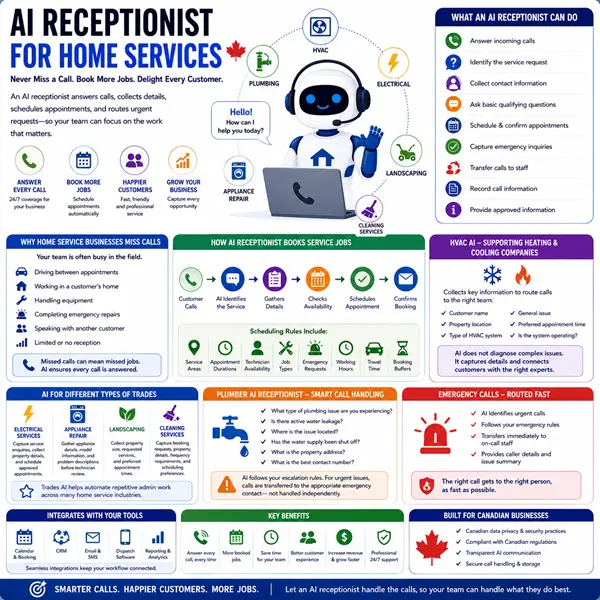
For a home service company, it may be able to:
- Answer incoming calls
- Identify the customer’s service request
- Collect contact information
- Ask basic qualifying questions
- Schedule appointments
- Confirm existing bookings
- Capture emergency inquiries
- Transfer calls to staff
- Record call information
- Provide approved business information
The exact capabilities depend on the platform and its integrations.
For example, a homeowner might call a plumbing company because of a leaking water heater. The AI receptionist can collect the customer’s name, address, preferred appointment time, and basic description of the issue before sending the information to the appropriate team.
This can create a smoother process from the initial call through to job scheduling.
Why Home Service Businesses Miss Valuable Calls
Trade businesses face a unique challenge: the people best qualified to answer customer questions are often out in the field.
A technician may be:
- Driving between appointments
- Working inside a customer’s home
- Handling equipment
- Completing an emergency repair
- Speaking with another customer
- Working in an area with limited reception
Meanwhile, calls continue coming in.
Missed calls can mean missed opportunities, particularly when customers need immediate assistance.
An AI receptionist can provide a consistent first point of contact even when the human team is unavailable.
How an AI Receptionist Can Book Service Jobs
Scheduling is one of the most practical applications for an AI receptionist.
Once connected to an approved scheduling system, the receptionist may be able to check available appointment windows and book jobs in accordance with the company’s rules.
A typical process could look like this:
Customer calls → AI identifies the service → gathers details → checks availability → schedules appointment → confirms booking
Businesses can establish rules around:
- Service areas
- Appointment durations
- Technician availability
- Job types
- Emergency requests
- Working hours
- Travel time
- Booking buffers
This reduces the amount of manual scheduling required from office staff.
HVAC AI: Supporting Heating and Cooling Companies
HVAC companies receive a wide variety of calls, from routine maintenance requests to urgent heating and cooling problems.
An HVAC AI receptionist can help organize these incoming inquiries by asking appropriate preliminary questions.
For example, it might collect:
- Customer name
- Property location
- Type of HVAC system
- General issue
- Preferred appointment time
- Whether the system is currently operating
The system should not attempt to diagnose complex technical problems unless specifically designed and authorized to do so. Instead, its role can be to capture useful information and connect the customer with the right team.
During busy periods, such as extreme winter or summer weather, this type of call handling can be particularly valuable.
How a Plumber AI Receptionist Can Handle Incoming Calls
Plumbing problems can range from routine maintenance to situations requiring immediate attention.
A plumber AI receptionist can help separate routine enquiries from potentially urgent calls by asking structured questions.
For example:
- What type of plumbing issue are you experiencing?
- Is there active water leakage?
- Where is the issue located?
- Has the water supply been shut off?
- What is the property address?
- What is the best contact number?
The AI can then follow the company’s escalation rules.
For potentially serious situations, the appropriate response may be to transfer the call to an emergency contact rather than attempting to handle the situation independently.
This distinction is important. AI should support the company’s response process, not replace professional judgment in situations requiring immediate technical assessment.
AI for Different Types of Trades
The potential applications extend beyond plumbing and HVAC.
Electrical Services
An AI receptionist can capture service enquiries, collect property information, and schedule approved appointment types.
Appliance Repair
Customers can provide appliance details, model information, and descriptions of the problem before a technician reviews the request.
Landscaping
AI can collect information about property size, requested services, and preferred appointment times.
Cleaning Services
Businesses can use AI to capture booking requests, property details, frequency requirements, and scheduling preferences.
This broader approach is why trades AI is becoming relevant to businesses looking for practical ways to automate repetitive administrative work.
Emergency Calls Require a Different Workflow
Emergency service calls should be treated differently from ordinary appointment requests.
An AI receptionist should follow clearly defined escalation procedures rather than making its own judgment about serious situations.
For example, a home service company could configure the system to:
- Identify that the caller describes an urgent situation.
- Collect essential contact and location information.
- Provide only approved safety instructions, where appropriate.
- Escalate the call according to the company’s emergency policy.
- Notify the appropriate staff member.
The system should never create a false impression that an emergency has been professionally assessed when it has not.
Clear escalation rules are therefore essential.
Capturing Leads While Technicians Are Working
Not every call is an emergency.
A customer might call to ask about:
- Installation pricing
- Maintenance plans
- Service availability
- Renovation projects
- Quotes
- Future appointments
If the technician cannot answer, the AI receptionist can capture the inquiry rather than allowing the lead to disappear.
This is an important part of service business AI.
The goal isn’t simply to answer more calls. It is to ensure that useful information reaches the right person so the business can follow up.
Connecting AI Receptionists With Existing Business Tools
The most effective systems can connect with the software a company already uses.
Potential integrations include:
- Calendars
- CRMs
- Job-management platforms
- Dispatch software
- Customer databases
- Messaging systems
For example, after receiving a call, an AI receptionist could create a customer record, schedule an approved appointment, and pass job information to the service management platform.
This eliminates unnecessary double entry and helps keep customer information organized.
Benefits for Canadian Home Service Businesses
An AI receptionist home services Canada strategy can offer several operational advantages.
Better Call Coverage
Calls can be answered when technicians or office staff are unavailable.
Faster Lead Capture
Customer information can be collected immediately instead of waiting for a callback.
Less Administrative Work
Routine questions and appointment requests can be handled automatically.
Improved Scheduling
Connected calendars can help organize appointments according to business rules.
Consistent Customer Experience
Every caller can receive a structured initial response based on approved information.
Support Outside Regular Hours
Depending on the system, businesses can provide basic call handling beyond traditional office hours.
What AI Should and Shouldn’t Handle
AI works best when its responsibilities are clearly defined.
Good Tasks for AI
- Appointment requests
- Basic FAQs
- Lead capture
- Customer information collection
- Appointment confirmations
- Call routing
- Service-area questions
Tasks Better Escalated to Humans
- Complex technical diagnosis
- Serious complaints
- Sensitive billing disputes
- Situations requiring professional judgement
- Emergency decisions beyond the company’s approved workflow
- Requests involving confidential information
A successful implementation gives AI a clear role rather than expecting it to handle every possible situation.
Conclusion
For Canadian HVAC, plumbing, electrical, and other home service businesses, managing incoming calls can be challenging when technicians spend most of their day in the field.
An AI receptionist home services Canada solution can provide an additional layer of call coverage by answering routine inquiries, capturing leads, scheduling approved appointments, and routing important requests to the right people.
From HVAC AI workflows to a plumber AI receptionist, the technology can be adapted to different trades and business processes. More broadly, trades AI can help companies reduce repetitive administrative work while keeping human professionals responsible for technical decisions and complex customer interactions.
The most effective approach is not to automate everything. Instead, businesses should identify repetitive tasks, establish clear escalation rules, connect the receptionist to appropriate systems, and continuously review how the workflow performs.
Frequently Asked Questions
1. What is an AI receptionist for home service companies?
An AI receptionist helps home service businesses answer calls, capture leads, collect customer information, schedule appointments, and route calls according to predefined business rules.
2. Can an AI receptionist book plumbing or HVAC appointments?
Yes, where the system is connected to an appropriate scheduling platform and configured with the company’s availability, service areas, and booking rules.
3. How does HVAC AI help service businesses?
An HVAC AI receptionist can collect information about heating and cooling enquiries, capture customer details, schedule suitable appointments, and escalate requests that require human attention.
4. What can a plumber AI receptionist do?
A plumber AI receptionist can answer routine calls, gather information about plumbing issues, capture service requests, schedule appointments, and route urgent inquiries according to company procedures.
5. Is Trades AI suitable for small businesses?
It can be. Small trade businesses often have limited administrative resources, so automating repetitive call-handling and scheduling tasks may help staff spend more time on customer service and field operations.
6. Can AI handle emergency service calls?
AI can support an emergency call workflow by collecting information and following predefined escalation procedures. It should not independently replace qualified professionals or make technical emergency assessments outside its authorized role.