When customers call a business, reaching the right person quickly can make a significant difference to their experience. Traditional phone systems often rely on fixed menus, transfers, and manual decisions. While these systems can work for basic call handling, they may become difficult to manage when a business has multiple departments, locations, or types of customer inquiries.
AI call routing offers a more flexible approach. Instead of relying only on keypad selections, an AI-powered system can listen to what a caller needs, identify the purpose of the call, and determine where the conversation should go next.
For Canadian businesses, this can help organize incoming calls across sales, customer service, support, bookings, and other departments.
This guide explains how AI-powered routing works, what intelligent call routing means, how skill-based routing AI can match calls with suitable staff, and how call triage AI can help prioritize urgent or complex inquiries.
What Is AI Call Routing?
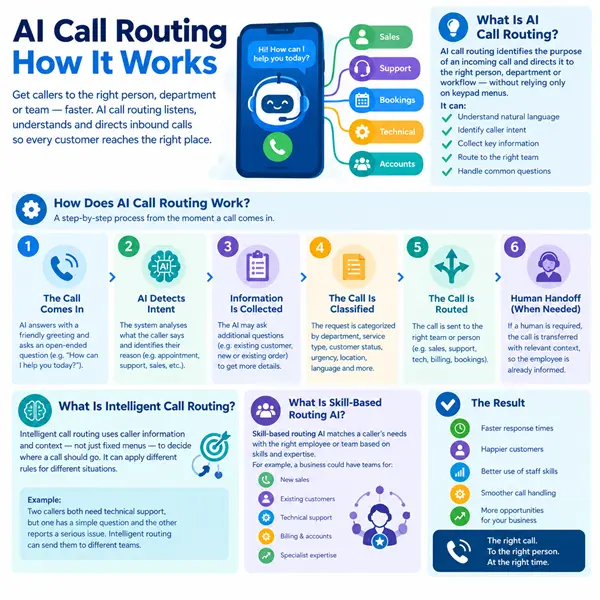
AI call routing is the use of artificial intelligence to identify the purpose of an incoming call and direct it to the appropriate person, department, or workflow.
Traditional routing may ask callers to choose an option such as
- “Press 1 for sales.”
- “Press 2 for support.”
- “Press 3 for billing.”
AI routing can instead allow the caller to explain their reason for calling naturally.
For example, a customer might say:
“I’m calling because my order hasn’t arrived yet.”
The system can identify that the caller is likely contacting customer support about an order and route the call accordingly.
The exact capabilities depend on the technology, integrations, and rules configured by the business.
How Does AI Call Routing Work?
The routing process typically involves several connected stages.
1. The Call Comes In
The process starts when a customer calls the business.
The AI voice system answers the call and provides an appropriate greeting. It can then ask an open-ended question such as
“How can I help you today?”
This allows the caller to explain what they need without navigating multiple menu options.
2. AI Detects the Caller’s Intent
The system analyses what the caller says to identify their intent.
A caller might be looking to:
- Book an appointment
- Speak with sales
- Get technical support
- Ask about an existing order
- Resolve a billing issue
- Request a quotation
- Report an urgent problem
The AI compares the conversation with predefined intents and workflows.
3. Information Is Collected
The system may ask additional questions if more information is needed before routing the call.
For example:
“Are you an existing customer?”
Or:
“Is this regarding a new purchase or an existing order?”
This additional information helps the system make a more accurate routing decision.
4. The Call Is Classified
Once the system understands the request, it can classify the call according to factors such as
- Department
- Service type
- Customer status
- Urgency
- Location
- Language
- Required expertise
This classification becomes the basis for the routing decision.
5. The Call Is Routed
The system then sends the call to the appropriate destination.
For example:
Sales enquiry → Sales representative
Technical problem → Technical support
Billing question → Accounts team
Appointment request → Booking team
The routing rules can be configured around the business’s structure.
6. Human Handoff Takes Place
If a human employee needs to handle the conversation, the AI can transfer the call.
Where supported, relevant information gathered during the initial conversation can be passed to the employee.
This means the employee may already know why the customer is calling instead of asking the customer to start from the beginning.
What Is Intelligent Call Routing?
Intelligent call routing refers to routing calls using information about the caller and their request rather than relying only on a fixed menu.
The system can consider multiple factors when deciding where a call should go.
For example, two callers may both contact a company about technical support, but their situations may be different.
One may have a simple account question, while another may be reporting a serious service problem.
An intelligent system can use the information gathered during the conversation to apply different routing rules.
This can create a more structured approach to call management.
What Is Skill-Based Routing AI?
Skill-based routing AI is a routing approach that attempts to match a caller’s needs with an employee or team that has the appropriate skills or expertise.
For example, a business could have separate teams for:
- New sales
- Existing customers
- Technical support
- Billing
- Account management
Instead of sending every caller to a general queue, the AI can identify the purpose of the call and route it towards the relevant skill group.
This can be particularly useful for businesses where employees have different areas of expertise.
How Skill-Based Routing Can Work
Imagine a customer calls a technology company and says they need help setting up a particular product.
The AI may identify the inquiry as technical support and determine which support team should handle it.
If another caller asks about purchasing a new service, the system can identify a sales-related intent and route the conversation differently.
The business can establish rules around which skills are required for different call types.
What Is Call Triage AI?
Call triage AI focuses on assessing incoming calls and determining their urgency, type, or appropriate next step.
The concept is similar to sorting incoming requests before they reach the person responsible for handling them.
For example, a business may classify calls as
- General inquiry
- Standard support request
- High-priority customer issue
- Urgent service problem
- Sales opportunity
- Appointment request
The system can then apply different routing or escalation rules to each category.
Call triage does not mean that AI should make every important decision independently. Businesses should establish clear rules for situations that require immediate human attention.
How Does AI Prioritise Calls?
Not every call has the same urgency.
An AI routing system can be configured to recognize specific indicators and apply priority rules.
For example, a business could establish a workflow where:
Routine enquiry → Standard queue
Existing customer issue → Customer support
High-priority account → Priority team
Defined urgent issue → Immediate human escalation
The actual rules should be based on the business’s requirements.
Clear escalation criteria are especially important when a call involves sensitive information, financial matters, safety concerns, or situations that require professional judgment.
AI Call Routing for Canadian Businesses
Canadian businesses can use AI routing across a variety of industries and customer service environments.
Potential applications include:
- Healthcare practices
- Property management
- Home services
- Professional services
- Automotive businesses
- Financial services
- Retail
- Technology companies
- Hospitality
- Education
A business operating across multiple locations can also establish routing rules based on location or service area.
For example, a caller from one service region could be directed to the appropriate local team rather than a central department.
What Are the Benefits of AI Call Routing?
Faster Connections
AI can identify the reason for a call before transferring it, potentially reducing unnecessary steps.
Fewer Unnecessary Transfers
When routing is based on caller intent, the system can direct calls towards the relevant team instead of relying entirely on manual transfers.
Better Use of Staff Time
Employees can spend less time sorting basic calls and more time handling conversations that require their expertise.
Consistent Routing
Automated rules can provide a consistent approach to handling similar inquiries.
Better Caller Context
When the system collects information before transferring a call, the receiving employee may have more context about the customer’s needs.
What Should Businesses Consider Before Implementing AI Routing?
AI routing works best when the business has clearly defined processes.
Before implementation, consider:
Define Common Call Types
List the most frequent reasons customers contact your business.
Create Clear Routing Rules
Determine which team or employee should handle each type of inquiry.
Establish Escalation Criteria
Identify situations where the AI should immediately involve a human.
Keep Information Updated
If the AI uses outdated business information, it may route or respond incorrectly.
Review Performance
Monitor call outcomes and identify areas where routing rules need adjustment.
Protect Customer Information
Businesses should establish appropriate processes for collecting, storing, and handling customer information in accordance with applicable privacy requirements.
Conclusion
Traditional phone menus can be useful for basic call management, but businesses with more complex customer needs may require a more flexible approach.
AI call routing allows incoming calls to be assessed according to caller intent, information provided during the conversation, and predefined business rules. Intelligent call routing can then direct the conversation towards the appropriate destination, while skill-based routing AI can help match inquiries with teams that have the relevant expertise.
Meanwhile, call triage AI can help classify calls by type or priority and trigger appropriate escalation when human involvement is required.
The most effective approach is to design routing around real customer journeys rather than simply automating every possible call. Clear workflows, accurate information, appropriate escalation rules, and human handoff should all form part of the system.
Frequently Asked Questions
1. What is AI call routing?
AI call routing uses artificial intelligence to understand why someone is calling and direct the conversation to the appropriate person, department, or workflow.
2. How is AI call routing different from traditional phone menus?
Traditional systems often depend on fixed menus and keypad selections. AI routing can use natural-language conversations to identify caller intent and determine the appropriate next step.
3. What does intelligent call routing mean?
Intelligent call routing uses information about the caller, their request, and predefined business rules to make routing decisions rather than relying only on a fixed sequence of menu options.
4. What is skill-based routing AI?
Skill-based routing AI matches incoming calls with teams or employees based on the expertise required to handle the caller’s request.
5. What does call triage AI do?
Call triage AI assesses incoming calls, identifies their type or urgency, and helps determine which workflow, queue, or employee should handle them.
6. Can AI route urgent calls?
Yes. Businesses can configure routing and escalation rules for defined urgent situations. However, the criteria should be carefully established so that important calls are transferred to appropriate human staff when required.
7. Can AI transfer callers to a person?
Yes. Human handoff can be included as part of an AI routing workflow. The system can transfer the caller when the request requires human assistance or when a predefined escalation condition is met.
8. Can AI routing work with existing phone systems?
It can, depending on the AI platform, telecommunications setup, and available integrations. Businesses should check compatibility before implementation.