
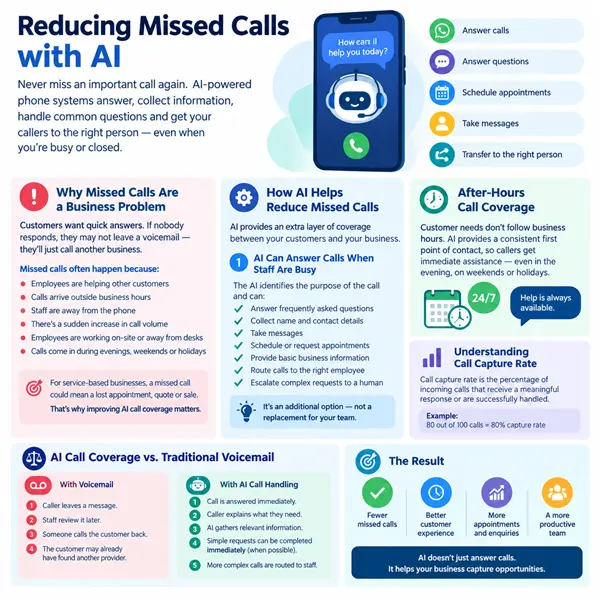
For many Canadian businesses, reducing missed calls AI is more than a missed conversation. It can mean a lost appointment, an unanswered customer question, or a potential sale going to a competitor. This becomes especially challenging when staff are busy, the business is closed, or several customers call at once.
Reducing missed calls with AI gives businesses a practical way to improve phone coverage without requiring employees to answer every call manually. AI-powered phone systems can answer calls, collect information, handle common questions, schedule appointments, and transfer callers to the right person when human assistance is needed.
The goal is not necessarily to replace staff. Instead, AI can help make sure important calls do not simply disappear when nobody is available.
Why Missed Calls Are a Business Problem
Customers often call because they want an immediate answer. If nobody responds, they may not leave a voicemail or call back later. They may simply contact another business.
Missed calls can happen for many ordinary reasons:
- Employees are already helping other customers.
- Calls arrive outside regular business hours.
- Staff are away from the phone.
- The business receives a sudden increase in call volume.
- Employees are working on-site or away from their desks.
- Calls come in during evenings, weekends, or holidays.
For service-based businesses, the impact can be significant. A missed call from someone looking for a quote, booking, repair, consultation, or appointment could represent a valuable opportunity.
This is where improving AI call coverage can make a difference.
How AI Helps Reduce Missed Calls
AI phone systems can provide an additional layer of coverage between the customer and the business. Instead of allowing an unanswered call to become a missed opportunity, the system can respond and determine what the caller needs.
AI Can Answer Calls When Staff Are Busy
A missed call AI system can answer incoming calls even when employees are already speaking with other customers.
The AI can start by identifying the purpose of the call and collecting basic information. Depending on how the system is configured, it may be able to:
- Answer frequently asked questions
- Collect a caller’s name and contact details
- Take messages
- Schedule or request appointments
- Provide basic business information
- Route calls to the appropriate employee
- Escalate more complicated requests to a human
This gives businesses another option besides sending every unanswered call directly to voicemail.
AI Provides After-Hours Call Coverage
Customer needs do not always follow business hours. Someone may need to book an appointment in the evening, ask about a service on the weekend, or request information before the business opens.
AI can provide a consistent first point of contact outside normal operating hours.
Instead of hearing only a voicemail message, callers can receive immediate assistance with tasks the AI has been designed to handle.
Understanding Call Capture Rate
One useful metric for measuring phone performance is call capture rate.
Simply put, call capture rate refers to the percentage of incoming calls that receive a meaningful response or are successfully handled rather than being missed.
For example, if a business receives 100 calls and effectively handles 80 of them, its basic call capture rate would be 80%.
The exact definition should be consistent within a business because different companies may count answered calls, qualified calls, appointments, or successfully transferred calls differently.
Tracking the metric over time can help businesses understand:
- How many calls are being missed
- When missed calls happen most often
- Whether staffing levels match call volume
- How many calls AI successfully handles
- Whether more callers are reaching the right person
- Whether call handling improvements lead to more appointments or enquiries
A higher capture rate does not automatically mean more sales, but it can provide a clearer picture of how effectively a business is responding to inbound demand.
AI Call Coverage vs. Traditional Voicemail
Traditional voicemail still has a place in business communications, but it puts the responsibility back on the caller.
A customer must leave a message, wait for someone to listen to it, and then wait for a response.
AI can create a more interactive experience.
With voicemail:
- The caller leaves a message.
- Staff review it later.
- Someone calls the customer back.
- The customer may already have found another provider.
With AI call handling:
- The call is answered immediately.
- The caller explains what they need.
- AI gathers relevant information.
- Simple requests can potentially be completed immediately.
- More complex calls can be routed to staff.
This does not mean AI should handle every situation. Human involvement remains important for sensitive, complicated, or high-value conversations.
Where AI Can Make the Biggest Difference
Some businesses naturally receive frequent phone enquiries, making call coverage particularly important.
These may include:
- Home service companies
- Dental and healthcare practices
- Property and real estate businesses
- Professional services
- Automotive businesses
- Restaurants and hospitality companies
- Appointment-based businesses
- Local retailers
For example, a Canadian HVAC company may receive calls from customers who need urgent service. If technicians are working in the field and nobody can answer the office phone, an AI receptionist can capture the caller’s information and understand the reason for the call.
The business can then follow up according to its normal process.
How to Improve Your Call Capture Rate with AI
Simply installing an AI phone system is not enough. The system should be designed around the way the business actually handles calls.
1. Identify When Calls Are Being Missed
Start by reviewing call records and identifying patterns.
Look for:
- Peak calling hours
- After-hours calls
- Repeated unanswered calls
- Calls abandoned quickly
- Days with unusually high call volume
This provides a baseline before introducing AI.
2. Define What AI Should Handle
Not every call needs the same response.
Create clear rules for common requests, such as:
- Appointment bookings
- Pricing enquiries
- Business hours
- Service availability
- Basic customer questions
- Lead qualification
- Message taking
Then establish situations where the AI should transfer the caller to a person.
3. Create a Human Escalation Path
A good AI system should know when it has reached its limits.
If a caller has a complex question, is frustrated, or needs something outside the AI’s capabilities, the system should have a clear escalation process.
This combination of automation and human support can provide broader coverage without making customers feel trapped in an automated system.
4. Measure Results
After implementation, monitor your call capture rate and related metrics.
Compare performance before and after AI implementation and look at whether:
- Fewer calls are missed
- More enquiries are captured
- More appointments are booked
- Staff spend less time answering repetitive questions
- Customers reach the right department faster
AI and Canadian Call Compliance
Canadian businesses should also consider telecommunications requirements when using automated calling technologies.
The CRTC’s Unsolicited Telecommunications Rules apply to certain telemarketing activities, including rules concerning consent, calling lists, identification, calling times, and automatic dialing-announcing devices. Businesses using AI for outbound or automated calls should review the applicable requirements rather than assuming that automation removes their responsibilities.
For inbound call handling, businesses should also consider privacy, recording, data handling, and their own industry-specific obligations.
The Future of AI Call Handling for Canadian Businesses
Reducing missed calls with AI is ultimately about making better use of the opportunities a business is already receiving.
AI does not need to replace the human phone experience. It can work alongside employees by answering when they cannot, handling routine conversations, collecting useful information, and helping route important calls.
For businesses that depend on phone enquiries, improving AI call coverage can turn an unanswered phone into an active customer conversation.
The key is to use AI strategically: automate repetitive tasks, make the caller experience simple, provide a clear path to human support, and measure whether the changes are actually improving call capture.
Frequently Asked Questions
1. What is reducing missed calls with AI?
Reducing missed calls with AI means using artificial intelligence to answer and manage incoming calls when employees are unavailable. Depending on the system, AI can answer questions, collect information, schedule appointments, take messages, or transfer callers.
2. What is missed call AI?
Missed call AI refers to AI-powered phone systems designed to respond to calls that might otherwise go unanswered. Instead of relying entirely on voicemail, the AI can interact with the caller and capture relevant information.
3. What is call capture rate?
Call capture rate is a measurement of how effectively a business responds to incoming calls. Businesses should define exactly what counts as a captured call and track the metric consistently.
4. Can AI answer calls after business hours?
Yes. AI phone systems can provide coverage outside normal operating hours, depending on how they are configured. They can handle approved tasks and collect information for follow-up.
5. Can AI transfer calls to employees?
Yes. AI systems can be configured to route certain calls to employees or departments based on the caller’s needs and the business’s workflow.
6. Does AI replace human customer service?
Not necessarily. AI can handle routine conversations and provide additional coverage, while employees can focus on complex, sensitive, or higher-value interactions.
7. Is AI call automation allowed in Canada?
AI and automated calling must be used in accordance with applicable Canadian telecommunications requirements. The CRTC regulates telemarketing and certain automated calling technologies, including automatic dialing-announcing devices. Businesses should review the rules that apply to their specific use case.