
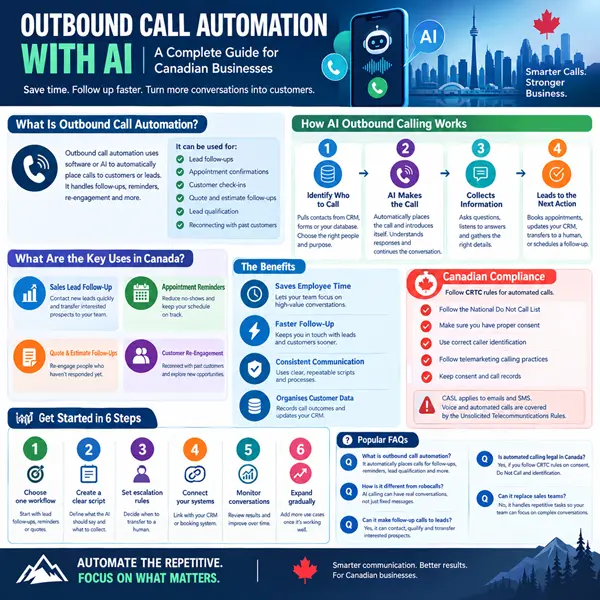
Making follow-up calls is an important part of sales and customer service, but it can also take up a significant amount of time. Businesses often have leads to contact, appointments to confirm, customers to check on, and prospects who need a reminder before taking the next step.
This is where outbound call automation can help. Instead of relying entirely on employees to make repetitive calls, businesses can use AI-powered systems to handle specific outbound conversations automatically.
For Canadian businesses, this technology can make follow-ups more consistent while allowing employees to spend more time on conversations that require human attention.
What Is Outbound Call Automation?
Outbound call automation is the use of software, AI, and automated phone systems to make calls to customers or leads without an employee manually dialling every number.
An automated system can work from information stored in a CRM or customer database. Depending on how it is configured, it can:
- Call leads after they submit an enquiry
- Follow up with potential customers
- Confirm appointments
- Send reminders through voice calls
- Check whether a customer still needs assistance
- Qualify leads before passing them to a sales representative
- Reconnect with previous customers
- Route interested callers to the appropriate employee
Traditional automated calling usually follows a fixed script. Modern AI outbound calling can be more conversational, allowing the system to respond based on what the person says.
How AI Outbound Calling Works
AI outbound calling combines several technologies to automate the calling process.
1. The System Identifies Who to Call
The process can begin with a CRM, lead form, booking system, or customer database. The business determines which contacts should receive a call and why.
For example, a company could create a workflow for:
- New leads
- Missed enquiries
- Upcoming appointments
- Quote follow-ups
- Customer renewals
2. AI Makes the Call
The system automatically places the call according to the workflow. When the customer answers, the AI can introduce itself and explain the reason for calling.
Rather than simply playing a recorded message, conversational AI can understand responses and continue the conversation according to predefined rules.
3. The AI Responds and Collects Information
The AI can ask questions, listen to answers, and collect relevant information.
For example, after a service enquiry, it might ask whether the customer is still interested, what type of service they need, and when they would prefer to speak with a specialist.
4. The Call Leads to the Next Action
Once the conversation is complete, the system can trigger the appropriate next step.
This could include:
- Booking an appointment
- Transferring the call to a human
- Updating the CRM
- Scheduling another follow-up
- Recording the outcome
- Marking the lead as unavailable
This makes automated calls more useful than simply dialling numbers at scale.
Common Uses for Automated Calls in Canada
Businesses across different industries can use automated calls for repetitive communication.
Sales Lead Follow-Up
Speed matters when a potential customer has recently shown interest. An AI system can contact a lead shortly after an enquiry rather than waiting for a salesperson to become available.
The AI can determine whether the person is interested and, when appropriate, transfer the conversation to a sales representative.
Appointment Reminders
Healthcare clinics, dental practices, home-service companies, and other appointment-based businesses can use automated calls to remind customers about upcoming bookings.
This can help reduce the amount of manual reminder work for staff.
Quote and Estimate Follow-Ups
A business can automatically contact someone who received a quote but has not responded.
Instead of employees manually reviewing every outstanding quote, AI can handle the initial follow-up and identify customers who want to continue.
Customer Re-Engagement
Businesses can also use follow up AI to reconnect with previous customers.
For example, an automated call could ask whether a previous customer needs another service, wants to renew a plan, or would like assistance with a new requirement.
Benefits of Outbound Call Automation
The main value of automated calls is not simply making more calls. It is reducing repetitive work while creating a more organised follow-up process.
Saves Employee Time
Employees do not need to spend hours manually dialling numbers and repeating basic questions.
AI can handle routine conversations while employees focus on complex customer needs, negotiations, and higher-value tasks.
Provides Faster Follow-Up
When a lead comes in outside normal working hours, an automated workflow can potentially respond according to the business’s configuration.
Faster follow-up can make it easier for businesses to maintain contact with prospects before they lose interest.
Creates Consistent Communication
Human employees may have different approaches to follow-ups. Automated workflows can use consistent scripts, questions, and business information.
This can make customer communication easier to manage across a growing team.
Helps Organise Customer Data
When connected with business systems, AI calling can record outcomes and update customer information.
Instead of relying on handwritten notes or memory, teams can have a clearer record of what happened during a call.
Outbound Call Automation and Canadian Compliance
Businesses using automated calls in Canada need to consider Canada’s telemarketing requirements.
The CRTC’s Unsolicited Telecommunications Rules cover telemarketing and automatically dialled calls. Requirements can include rules around the National Do Not Call List, identification, calling practices, and consent.
Businesses should also understand the distinction between telephone calls and electronic messages. The CRTC explains that CASL applies to commercial electronic messages such as email and SMS, while live voice and automated telemarketing calls to telephone numbers are regulated under the Unsolicited Telecommunications Rules.
Keep Consent and Calling Records
Where express consent is required, businesses should maintain records showing how consent was obtained. The CRTC states that the responsibility for demonstrating valid express consent can fall on the telemarketer or its client.
A practical compliance process should include:
- Maintaining accurate customer records
- Checking applicable Do Not Call requirements
- Respecting withdrawal requests
- Keeping appropriate consent records
- Clearly identifying the business when required
- Reviewing scripts and automated workflows regularly
Because requirements can depend on the type and purpose of a call, Canadian businesses should review the current rules before launching an automated calling campaign.
How to Get Started with AI Outbound Calling
Businesses do not need to automate every phone conversation immediately.
A better starting point is to identify repetitive calls that follow a predictable process.
Consider:
- Choose one workflow: Start with lead follow-ups, reminders, or quote calls.
- Create a clear script: Define what the AI should say and what information it should collect.
- Set escalation rules: Decide when the AI should transfer the conversation to a person.
- Connect your systems: Where appropriate, connect the calling platform with your CRM or booking system.
- Monitor conversations: Review results and identify areas where the AI needs improvement.
- Expand gradually: Once the initial workflow works well, introduce additional use cases.
The Future of AI Outbound Calling
Outbound calling is moving beyond simple prerecorded messages. AI can now support more interactive conversations, making automated follow-up feel more natural and useful.
For Canadian businesses, the opportunity is not necessarily to replace employees. Instead, AI can take care of repetitive communication so employees can focus on conversations where human judgement and personal interaction matter most.
When implemented carefully, outbound call automation can become part of a broader customer communication strategy connecting leads, customers, employees, and business systems in one streamlined workflow.
Frequently Asked Questions
1. What is outbound call automation?
Outbound call automation uses software or AI to automatically place calls to selected customers or leads. It can be used for follow-ups, reminders, lead qualification, customer re-engagement, and other repetitive communication.
2. How does AI outbound calling differ from robocalls?
Traditional robocalls often rely on prerecorded messages or fixed menus. AI outbound calling can support conversational interactions by understanding responses and adjusting the conversation based on predefined business rules.
3. Can AI make follow-up calls to leads?
Yes. AI can be configured to contact leads after an enquiry, ask qualifying questions, provide basic information, and transfer interested prospects to a human representative when appropriate.
4. Is automated calling legal in Canada?
Automated calling is subject to Canadian telecommunications and telemarketing rules. Businesses need to understand applicable CRTC requirements, including rules concerning consent, Do Not Call requirements, caller identification, and automated calls.
5. Can AI outbound calls replace sales teams?
AI can automate repetitive parts of the sales process, but many businesses still benefit from human representatives for complex questions, negotiations, relationship-building, and final purchasing decisions.