
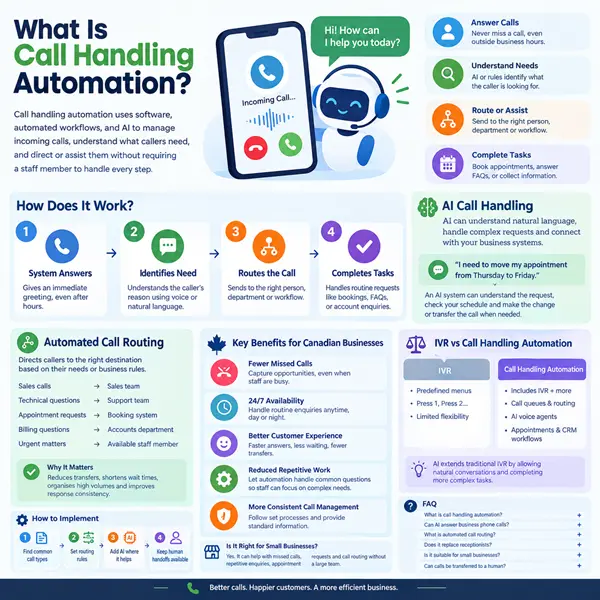
When a customer calls a business, they usually expect a quick answer, clear information, and the right person to help them. But for many Canadian businesses, handling every call manually can become difficult as call volumes grow. Missed calls, long wait times, repetitive questions, and incorrect transfers can all affect the customer experience.
This is where call handling automation comes in. It uses software, automated workflows, and increasingly artificial intelligence (AI) to manage incoming calls, understand what callers need, and direct or assist them without requiring a staff member to handle every step.
What Is Call Handling Automation?
Call handling automation is the use of technology to automatically manage incoming and sometimes outgoing business calls.
In simple terms, it allows a phone system to perform tasks that would traditionally require a receptionist or customer service employee. Depending on the system, this may include answering calls, identifying the caller’s reason for calling, providing information, routing the call, scheduling appointments, or transferring the caller to a team member.
Traditional business phone systems can already automate basic routing through menus, queues, and predefined rules. Modern AI-powered systems can go further by allowing callers to speak naturally instead of relying entirely on fixed keypad menus.
Call Automation Definition
A simple call automation definition is:
Call automation is the use of technology to automatically answer, process, route, and manage business phone calls according to predefined rules or intelligent AI-based workflows.
The goal is not necessarily to remove people from the process. Instead, automation can handle routine interactions while employees focus on calls that genuinely require human attention.
How Does Call Handling Automation Work?
A typical automated call-handling system follows several steps when someone calls a business.
1. The System Answers the Call
Instead of allowing a call to ring unanswered, an automated system can greet the caller immediately. This can be especially useful outside regular business hours.
2. It Identifies the Caller’s Need
The system may ask why the person is calling and use their response to determine the appropriate next step.
For example, a caller might say:
- “I want to book an appointment.”
- “I need help with my order.”
- “Can I speak with someone about billing?”
- “What are your business hours?”
AI call handling can interpret natural language and use that information to determine how the conversation should proceed.
3. The Call Is Routed or Handled
Once the caller’s intent is identified, the system can send the call to the appropriate person, department, or workflow. Modern voice systems can route calls to individuals, call queues, or other destinations based on configured rules.
4. The System Completes Routine Tasks
Some automated systems can do more than transfer calls. Depending on the business setup, they may help with:
- Appointment scheduling
- Frequently asked questions
- Order or account enquiries
- Lead qualification
- Customer information collection
- Basic troubleshooting
- Call-back requests
This means a customer may be able to complete a simple request without waiting for an employee.
What Is AI Call Handling?
AI call handling is a more advanced form of call automation that uses artificial intelligence to understand and respond to callers.
Unlike a traditional automated menu that may say, “Press 1 for sales, press 2 for support,” an AI voice system can allow a caller to explain what they need in ordinary language.
For example:
Caller: “I need to move my appointment from Thursday to Friday.”
An AI-powered system could understand the request, check the appropriate scheduling workflow, and either make the change or transfer the caller to an employee when necessary.
Modern AI voice agents can also connect with business workflows and systems to support tasks such as appointment management, billing enquiries, and order-related questions.
What Is Automated Call Routing?
Automated call routing is the process of automatically directing a caller to the appropriate destination based on information such as their request, department, availability, or predefined business rules.
For example:
- Sales calls → Sales team
- Technical questions → Support team
- Appointment requests → Booking system
- Billing questions → Accounts department
- Urgent matters → Available staff member
Businesses have used automated attendants and call queues for years, but AI can make routing more conversational by understanding what the caller is actually asking for rather than relying only on menu selections.
Why Automated Routing Matters
Poor routing can create unnecessary frustration. A customer may have to repeat their issue several times before reaching the right person.
Automated routing can help:
- Reduce unnecessary transfers
- Shorten the time needed to reach the right department
- Organise high call volumes
- Improve response consistency
- Give staff more time for complex customer needs
Benefits of Call Handling Automation for Canadian Businesses
For Canadian businesses, automated call handling can be useful across industries such as healthcare, professional services, home services, retail, hospitality, and many other customer-facing sectors.
Fewer Missed Calls
A business cannot respond to an opportunity it never answers. Automation can provide an immediate response when employees are busy or unavailable.
24/7 Availability
Automated systems can continue handling routine enquiries outside normal working hours, giving customers another way to get assistance without waiting for the next business day.
Better Customer Experience
Customers generally want simple answers without unnecessary waiting or transfers. A well-designed automated system can create a smoother path from the initial call to the appropriate solution.
Reduced Repetitive Work
Employees often spend significant time answering the same basic questions. Automation can handle common enquiries so staff can concentrate on more complicated conversations.
More Consistent Call Management
Automated workflows follow configured processes consistently. This can help businesses provide standard information and route calls according to established rules.
Is Call Handling Automation the Same as an IVR?
Not exactly.
An IVR (Interactive Voice Response) system usually relies on predefined menus and commands. For example, callers may be asked to press numbers to select a department.
Call handling automation is a broader concept. It can include:
- IVR menus
- Automatic call queues
- Call forwarding
- Automated routing
- AI voice agents
- Appointment automation
- CRM-connected workflows
AI systems can extend traditional IVR by allowing more natural conversations and completing more complex workflows.
How to Implement Call Handling Automation
Businesses should start with the calls they receive most often rather than trying to automate everything immediately.
Identify Common Call Types
Review your incoming calls and identify repetitive requests, common questions, and calls that are frequently transferred.
Define Routing Rules
Decide where different types of calls should go and what should happen when the intended employee is unavailable.
Add AI Where It Makes Sense
AI can be useful for conversational tasks, qualification, appointment management, and routine questions. More sensitive or complicated issues can still be transferred to a human.
Keep Human Handoffs Available
Automation works best when customers can reach a person when they genuinely need one. A good system should recognise situations that require human involvement and transfer the call appropriately.
The Future of Automated Call Handling
Call handling is moving beyond simple “press 1” menus. AI-powered voice systems are increasingly capable of understanding conversations, performing tasks, connecting with business systems, and routing callers based on their needs.
For businesses, the opportunity is not simply to automate phone calls. It is to create a better process around every call from the first greeting to the final resolution.
When implemented thoughtfully, call handling automation can help businesses respond faster, reduce repetitive workload, and give customers a more convenient way to communicate.
Frequently Asked Questions
1. What is call handling automation?
Call handling automation uses software, automated rules, or AI to answer, manage, route, and process business calls with less manual intervention.
2. Can AI answer business phone calls?
Yes. AI voice systems can answer calls, understand common requests, provide information, perform certain tasks, and transfer callers to employees when necessary.
3. What is automated call routing?
Automated call routing directs incoming calls to the appropriate person, department, queue, or workflow based on predefined rules or the caller’s needs.
4. Does call automation replace receptionists?
Not necessarily. It can reduce repetitive work and handle routine calls, while receptionists and other employees continue managing complex, sensitive, or high-value conversations.
5. Is call handling automation suitable for small businesses?
Yes. Small businesses can use automation to manage missed calls, repetitive enquiries, appointment requests, and call routing without requiring a large customer service team.
6. Can automated calls be transferred to a human?
Yes. Human handoff can be built into automated call workflows so that callers can be transferred when their request is too complex, sensitive, or outside the system’s capabilities.