
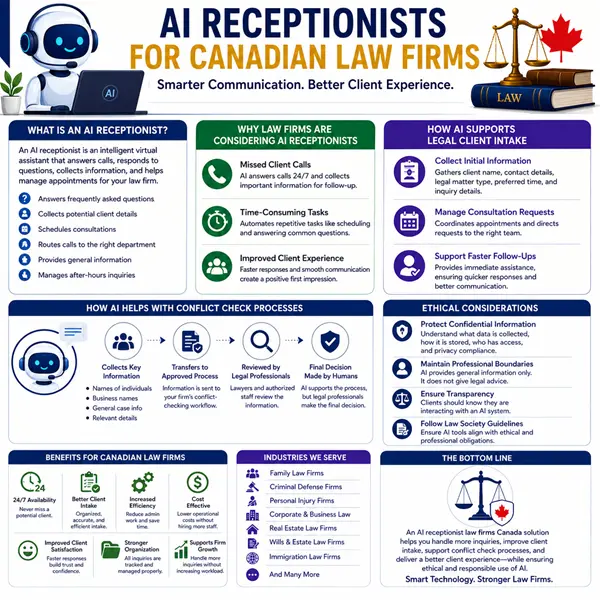
For many law firms, the first interaction with a potential client happens before a lawyer ever reviews a case. A missed call, delayed response, or incomplete intake process can affect the client experience and may even result in lost opportunities.
As legal practices continue adopting new technology, many firms are exploring how an AI receptionist law firms Canada solution can support their daily operations. AI receptionists can help manage client calls, collect initial information, schedule appointments, and organize inquiries while allowing legal teams to focus on more complex responsibilities.
However, adopting AI in a legal environment requires careful consideration. Law firms handle confidential client information, and any technology used must support privacy, accuracy, and ethical obligations.
This guide explains how AI receptionists can support Canadian law firms, improve client intake processes, and create more efficient communication systems without replacing the essential role of legal professionals.
What Is an AI Receptionist for Canadian Law Firms?
An AI receptionist is an artificial intelligence-powered communication tool designed to handle routine administrative interactions. It can answer client calls, respond to common questions, collect basic information, and help manage appointments.
Unlike traditional automated phone systems that provide limited menu options, modern AI receptionists can understand conversations and respond in a more natural way.
For legal practices, a legal AI receptionist is designed to support administrative tasks rather than provide legal advice or make decisions on behalf of lawyers.
Common tasks an AI receptionist can assist with include:
- Answering frequently asked questions
- Collecting potential client details
- Scheduling consultations
- Routing calls to the correct department
- Providing general information about firm services
- Managing after-hours inquiries
The goal is to make communication more efficient while ensuring lawyers and legal staff can dedicate more time to client matters.
Why Are Canadian Law Firms Considering AI Receptionists?
Law firms often receive a high volume of calls and inquiries from people looking for legal assistance. Managing every interaction manually can become challenging, especially for smaller practices with limited administrative resources.
A Canadian law firm AI approach allows firms to improve communication by using technology to handle repetitive tasks and organize incoming requests.
Some common challenges AI receptionists can help address include:
Missed Client Calls
Potential clients may contact a law firm outside business hours or when staff members are unavailable. An AI receptionist can provide immediate assistance and collect important information for follow-up.
Time-Consuming Administrative Tasks
Reception teams often spend significant time handling repeated questions, scheduling appointments, and collecting basic client information. AI can assist with these routine activities.
Improving Client Experience
People contacting law firms are often dealing with urgent or stressful situations. Faster responses and smoother communication can create a more positive first impression.
How AI Receptionists Support Legal Client Intake
Client intake is one of the most important processes in legal operations. It allows firms to collect information about potential clients and determine whether their needs match the firm’s services.
An intake AI legal solution can support this process by gathering preliminary details before a staff member or lawyer reviews the inquiry.
Collecting Initial Client Information
An AI receptionist can collect basic information such as:
- Client name
- Contact details
- Type of legal matter
- Preferred consultation times
- General details about the inquiry
This creates a more organised starting point for legal teams and reduces the time required during the initial conversation.
Managing Consultation Requests
Scheduling consultations manually can take valuable administrative time. AI receptionists can help coordinate appointments by collecting availability information and directing requests to the appropriate team.
This allows staff members to focus on supporting existing clients and managing more complex tasks.
Supporting Faster Follow-Ups
Quick responses are important in legal services. When potential clients receive immediate assistance, firms can respond faster and maintain better communication throughout the intake process.
How AI Helps With Conflict Check Processes
Conflict checks are a critical responsibility for law firms. Before accepting a new client, firms need to review whether any conflicts of interest exist.
AI receptionists can support this process by collecting relevant information during the initial inquiry stage.
For example, an AI system may collect the following:
- Names of individuals involved
- Business names connected to the matter
- General case information
- Relevant details required for review
This information can then be transferred to the firm’s approved conflict-checking process.
It is important to understand that AI does not replace legal judgment. Lawyers and authorized staff members remain responsible for reviewing information and making final decisions regarding conflicts.
Ethical Considerations When Using AI Receptionists in Law Firms
Legal technology must be implemented carefully because law firms have strict responsibilities regarding client privacy and confidentiality.
When using an AI receptionist law firms Canada solution, firms should consider the following factors:
Protecting Confidential Client Information
Law firms should carefully evaluate how an AI system collects, stores, and manages information.
Before implementation, firms should understand:
- What data the system processes
- How information is protected
- Who has access to collected information
- Whether the technology aligns with privacy requirements
Confidentiality should remain a priority throughout the entire process.
Preventing Unauthorised Legal Advice
AI receptionists should not provide legal advice, interpret laws, or make decisions that require professional legal expertise.
Their role should remain focused on administrative support, communication, and information collection.
Maintaining Human Review
AI works best as a support tool. Legal professionals should continue reviewing important information and handling situations that require experience, judgment, and personal communication.
Benefits of Using a Legal AI Receptionist
A properly implemented legal AI receptionist can provide several benefits for Canadian law firms.
Improved Availability
Clients may need assistance outside regular office hours. AI receptionists can provide continuous support, ensuring inquiries are captured even when staff members are unavailable.
Reduced Administrative Pressure
By managing repetitive communication tasks, AI can reduce workload for reception teams and allow employees to focus on higher-value responsibilities.
More Consistent Client Communication
AI systems can provide consistent responses based on approved information. This helps firms maintain communication standards and reduce delays.
Better Organisation of Client Information
AI-assisted intake systems can collect and organize information in a structured format, making it easier for legal teams to review new inquiries.
AI Receptionists Compared With Traditional Legal Receptionists
AI receptionists and human receptionists both offer valuable benefits, but they support different areas of legal communication.
An AI receptionist is useful for handling repetitive administrative tasks such as answering common questions, collecting basic information, and managing appointment requests. It can help firms improve response times and handle a larger volume of inquiries without increasing administrative workload.
A human receptionist provides something technology cannot fully replace: personal understanding and emotional connection. Legal matters are often sensitive, and clients may appreciate speaking with someone who can listen carefully, understand concerns, and provide a more personal experience.
For many law firms, the most effective approach may be combining both options. AI can manage routine communication while human team members focus on complex conversations and relationship-building.
How Canadian Law Firms Can Successfully Implement AI Receptionist Technology
Before introducing AI tools, law firms should create a clear strategy.
Identify Suitable Tasks
Start with administrative activities that do not require legal judgment, such as:
- Appointment scheduling
- Basic client inquiries
- Initial information collection
Select a Secure AI Solution
Law firms should evaluate technology providers carefully and consider factors such as security features, privacy practices, and integration options.
Train Staff on AI Usage
Employees should understand how the system works and when human involvement is required.
Monitor and Improve Performance
Regular reviews help firms identify areas for improvement and ensure the technology continues supporting their goals.
Conclusion
Technology is changing how law firms manage communication, and AI receptionists are becoming an increasingly useful tool for improving administrative efficiency.
An AI receptionist law firms Canada solution can help legal practices manage client calls, support intake processes, and improve response times when implemented responsibly. However, successful adoption requires attention to confidentiality, ethical considerations, and human oversight.
The future of legal communication is not about replacing people with technology. It is about using technology to support legal professionals and create better experiences for clients.
By combining AI tools with human expertise, Canadian law firms can build more efficient, organized, and client-focused workflows.
Frequently Asked Questions
1. Can an AI receptionist provide legal advice?
No. An AI receptionist should only support administrative tasks such as answering general questions, collecting information, and scheduling appointments. Legal advice should always come from qualified legal professionals.
2. How can an AI receptionist help Canadian law firms?
An AI receptionist law firms Canada solution can help manage client calls, improve intake processes, organize inquiries, and support faster communication.
3. Is AI suitable for handling legal client information?
AI can support legal communication, but firms should carefully review privacy, security, and confidentiality requirements before implementing any technology.
4. What is an intake AI legal system used for?
An intake AI legal system helps collect initial client information, organize inquiries, and support the early stages of client communication.
5. Will AI replace legal receptionists?
AI is designed to support legal teams rather than completely replace human employees. Receptionists continue to provide valuable communication skills, empathy, and client relationship support.