Businesses today need faster and smarter ways to handle customer calls. Traditional IVR systems with long menus often frustrate users and create delays. This is why many companies are now using AI voice agents to improve customer communication.
AI voice agents can answer calls, understand spoken language, respond naturally, and complete tasks like booking appointments, routing calls, and answering customer questions. Powered by conversational AI, these systems help businesses provide faster and more efficient support.
In this blog, we will explore how AI voice agents work and how they handle calls in real time.
What Are AI Voice Agents?
AI voice agents are intelligent systems that communicate with users through voice conversations. Unlike traditional automated phone systems, they can understand natural speech and respond conversationally.
AI voice agents can:
- Answer incoming calls
- Understand customer intent
- Handle repetitive support tasks
- Transfer calls when needed
- Provide 24/7 assistance
These capabilities make conversational AI calls more natural and efficient.
How AI Voice Agents Work
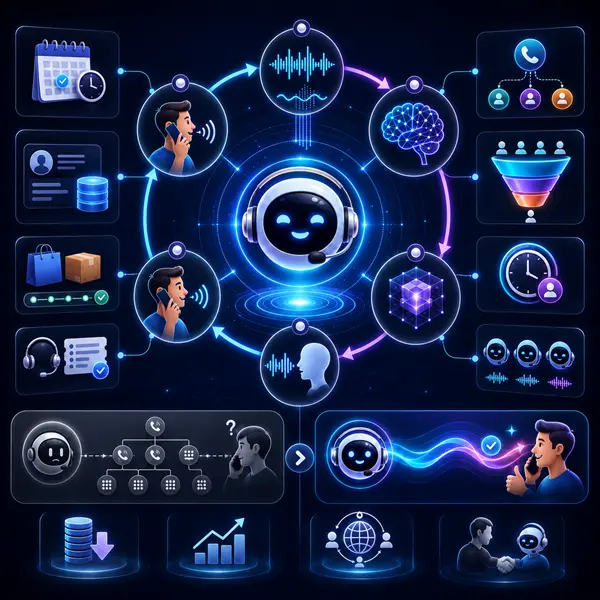
AI voice agents follow a structured voice AI workflow during every conversation.
Basic Voice AI Workflow
The process usually works like this:
- The caller speaks
- Speech is converted into text
- AI analyzes the meaning and intent
- The system generates a response
- Text is converted back into speech
- The caller hears the reply
This process happens within seconds to keep conversations smooth and natural.
Core Technologies Behind AI Voice Agents
Speech-to-Text Technology
Converting Voice Into Text
Speech-to-text technology converts spoken words into written text so the AI can understand the conversation.
Modern systems can recognize:
- Different accents
- Fast speech
- Background noise
- Multiple languages
This technology is the foundation of AI call handling.
Natural Language Understanding (NLU)
Understanding Customer Intent
After speech is converted into text, the AI analyzes what the customer actually means.
It identifies:
- User intent
- Keywords
- Dates and names
- Emotional tone
- Conversation context
For example, if a customer says:
“I want to reschedule my appointment.”
The AI understands the request and continues the conversation accordingly.
Large Language Models (LLMs)
The Intelligence Behind Conversational AI Calls
Large language models help AI voice agents generate natural and human-like responses.
They allow the AI to:
- Understand follow-up questions
- Maintain conversation flow
- Respond dynamically
- Handle unexpected questions
This makes modern AI voice agents far more advanced than traditional IVR systems.
Text-to-Speech Technology
Turning Text Into Speech
Once the AI generates a response, text-to-speech technology converts it into spoken language.
Modern AI voices sound more natural and conversational, helping create smoother customer interactions.
Real-Time Call Handling
Fast Responses
AI voice agents process information in milliseconds to avoid delays during conversations.
This includes:
- Speech recognition
- Intent analysis
- Response generation
- Voice synthesis
Fast processing helps conversations feel more human.
Handling Interruptions
Modern AI voice agents can also handle interruptions naturally.
If a caller interrupts while the AI is speaking, the system:
- Stops speaking
- Processes the new input
- Responds immediately
This creates a smoother conversation experience.
Integration With Business Systems
AI voice agents can connect with business tools such as:
- CRM platforms
- Scheduling systems
- Ecommerce platforms
- Helpdesk software
What AI Voice Agents Can Do
These integrations allow AI systems to:
- Book appointments
- Check order statuses
- Create support tickets
- Transfer calls intelligently
This improves efficiency and reduces manual work.
Common Use Cases for AI Voice Agents
1.Customer Support
AI voice agents help businesses:
- Answer FAQs
- Handle billing questions
- Track orders
- Provide account support
2. Appointment Scheduling
Businesses use conversational AI calls to:
- Schedule appointments
- Confirm bookings
- Send reminders
- Handle cancellations
3. Lead Qualification
Sales teams use AI voice agents to:
- Collect customer information
- Ask qualifying questions
- Route leads to representatives
Benefits of AI Voice Agents
1. 24/7 Availability
AI systems can answer calls anytime without breaks.
2. Reduced Costs
Businesses can automate repetitive tasks and reduce support costs.
3. Faster Customer Service
AI voice agents reduce wait times and provide instant responses.
4. Better Scalability
AI systems can handle multiple calls simultaneously.
Challenges of AI Voice Agents
Complex Conversations
AI may struggle with:
- Emotional discussions
- Technical issues
- Complex requests
Accent and Noise Issues
Strong accents and noisy environments can impact speech recognition accuracy.
AI Voice Agents vs Traditional IVR Systems
Traditional IVR Systems
Older IVR systems:
- Use fixed menus
- Require keypad input
- Often frustrate callers
Modern AI Voice Agents
Conversational AI calls:
- Understand natural speech
- Respond dynamically
- Handle interruptions
- Provide more human-like conversations
This is why businesses are replacing traditional IVR systems with AI-powered solutions.
In Summary
AI voice agents are transforming how businesses handle phone communication. By combining speech recognition, natural language understanding, large language models, and voice synthesis, these systems can deliver fast and intelligent customer interactions.
Understanding how AI voice agents work involves looking at the complete voice AI workflow behind every conversation. From processing speech to generating responses, multiple technologies work together in real time to create natural conversations.
As conversational AI technology continues improving, AI voice agents will become an even bigger part of customer support and business communication.
Frequently Asked Questions
Q1. What is an AI voice agent?
An AI voice agent is a system that can answer calls, understand spoken language, and respond naturally using artificial intelligence.
Q2. How AI voice agents works during calls?
AI voice agents convert speech into text, analyze the meaning, generate responses, and convert text back into speech.
Q3. What is a voice AI workflow?
A voice AI workflow is the process AI systems use to manage conversations, including speech recognition, intent analysis, and response generation.
Q4. Can AI voice agents replace human agents?
AI voice agents can automate repetitive tasks, but complex or emotional situations may still require human support.
Q5. What are the benefits of call handling AI?
Benefits include:
- Faster support
- Lower costs
- 24/7 availability
- Better scalability
- Improved customer experience