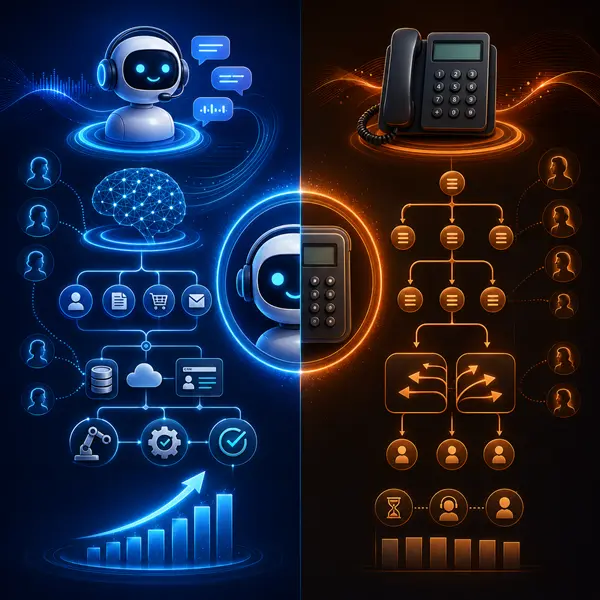
Customer communication systems have evolved significantly over the last decade. Businesses are now moving beyond traditional phone menus and exploring smarter conversational technologies. This shift has increased interest in AI voice agents vs IVR solutions, especially for companies aiming to improve customer support and operational efficiency.
Traditional IVR systems have been widely used for routing calls and handling simple customer requests. However, modern businesses are increasingly adopting AI-powered systems that provide more natural interactions and better intent recognition. As customer expectations continue to rise, organizations are evaluating whether a traditional IVR setup is still sufficient or if an IVR replacement powered by AI offers better long-term value.
This guide explains the major differences between AI voice agents and traditional IVR systems, including functionality, caller experience, scalability, and automation capabilities.
Our Story & Philosophy Behind Voice Automation
Overview
Communication technology has shifted from rigid button-based systems to intelligent conversational platforms. The discussion around voice AI vs IVR reflects a broader move toward automation that prioritizes customer experience and operational efficiency.
Core Philosophy
- Simplify customer communication
- Reduce wait times
- Improve intent recognition
- Enable intelligent automation
- Deliver better caller experiences
Technology Evolution
- Traditional keypad menus
- Speech recognition systems
- AI-powered conversational agents
- Real-time language understanding
- Predictive voice automation
Modern businesses are increasingly replacing static phone menus with intelligent phone menu AI systems capable of handling dynamic conversations.
What Are Traditional IVR Systems?
Overview
Interactive Voice Response (IVR) systems are automated phone systems that guide callers through pre-recorded menu options.
Core Functions
- Call routing
- Keypad input collection
- Basic speech recognition
- Queue management
- Automated responses
Typical IVR Structure
“Press 1 for Sales.”
“Press 2 for Support.”
“Press 3 for Billing.”
This structure works for simple call flows but often creates friction when customers have more complex requests.
Business Impact
- Reduced manual call handling
- Basic automation capabilities
- Lower staffing requirements
However, traditional IVR systems can become frustrating when callers cannot quickly reach the right solution.
What Are AI Voice Agents?
Overview
AI voice agents are intelligent conversational systems powered by artificial intelligence and natural language processing (NLP). Unlike static IVR menus, they can understand spoken language and respond dynamically.
Core Functions
- Natural conversation handling
- Intent recognition
- Real-time responses
- CRM integration
- Automated workflow execution
How They Work
Instead of pressing buttons, callers speak naturally:
- “I want to reschedule my appointment.”
The AI voice agent interprets the request, identifies the intent, and acts automatically.
Business Impact
- Faster customer support
- Improved caller satisfaction
- Reduced call abandonment
- Scalable automation systems
AI Voice Agents vs IVR-Key Differences
Natural Language Processing
Traditional IVR
Traditional IVR systems rely heavily on fixed menus and limited command recognition.
AI Voice Agents
AI voice agents use NLP to understand conversational language and context.
User Impact
- More natural interactions
- Reduced customer frustration
- Faster issue resolution
This is one of the most important differences in the AI voice agents vs IVR comparison.
Intent Handling
Traditional IVR
IVR systems often struggle with unexpected responses or complicated requests.
AI Voice Agents
AI systems identify customer intent even when phrasing varies.
Examples:
- “I need help with my bill.”
- “Why was I charged twice?”
- “Can you explain this payment?”
The AI recognizes all of these as billing-related intents.
Business Impact
- Improved accuracy
- Better routing efficiency
- Reduced escalation rates
Caller Experience
Traditional IVR
Many users dislike long menu trees and repetitive prompts.
AI Voice Agents
AI creates conversational and personalized interactions.
Experience Improvements
- Reduced hold times
- Faster answers
- Human-like conversations
- Personalized responses
Modern customers increasingly prefer conversational systems over rigid phone menus.
Flexibility & Scalability
Traditional IVR
Updating IVR systems often requires manual scripting and technical configuration.
AI Voice Agents
AI systems adapt more dynamically and integrate easily with business platforms.
Business Impact
- Faster deployment
- Easier scaling
- Better adaptability
This flexibility makes AI a strong IVR replacement for growing businesses.
Automation Capabilities
Traditional IVR
Automation is limited to predefined pathways.
AI Voice Agents
AI can automate:
- Appointment scheduling
- CRM updates
- Payment processing
- Ticket creation
- Follow-up communication
Operational Impact
- Reduced manual workload
- Increased operational efficiency
- Improved workflow automation
Modern IVR – Bridging Traditional and AI Systems
Overview
Some businesses are adopting modern IVR systems that combine traditional routing with AI features.
Features of Modern IVR
- Voice recognition
- Conversational prompts
- AI-assisted routing
- Hybrid automation
Advantages
- Easier transition from legacy systems
- Lower implementation complexity
- Improved caller experience
Limitations
- Still partially menu-dependent
- Limited conversational depth compared to full AI systems
Benefits of AI Voice Agents
Overview
Businesses implementing AI voice systems gain operational and customer service advantages.
Key Benefits
- 24/7 customer support
- Faster response times
- Lower operational costs
- Better customer engagement
- Improved scalability
Long-Term Value
AI voice systems continue learning and improving through data and interaction patterns.
Challenges of Replacing Traditional IVR
Overview
Despite the advantages, moving from IVR to AI involves planning and investment.
Common Challenges
- Initial setup costs
- Integration complexity
- Staff training requirements
- Data privacy concerns
Recommended Approach
- Start with hybrid systems
- Automate repetitive workflows first
- Integrate AI gradually
This phased strategy reduces implementation risk.
Industries Using AI Voice Agents
Healthcare
- Appointment scheduling
- Patient reminders
- Insurance verification
E-Commerce
- Order tracking
- Refund requests
- Customer support
Real Estate
- Lead qualification
- Property inquiries
- Follow-up calls
Financial Services
- Account support
- Payment reminders
- Fraud alerts
The rise of phone menu AI is transforming communication across industries.
Future of AI Voice Agents vs IVR
Overview
The future of customer communication is increasingly AI-driven.
Emerging Trends
- Emotion detection in voice AI
- Multilingual support
- Real-time analytics
- Hyper-personalized conversations
- AI-human hybrid systems
Long-Term Outlook
Traditional IVR systems may continue to exist for basic routing, but AI-powered conversational systems are becoming the preferred standard for customer interaction.
Conclusion
The comparison between AI voice agents vs IVR highlights a major shift in business communication technology. Traditional IVR systems still serve basic automation needs, but modern businesses increasingly require intelligent systems capable of understanding customer intent and delivering conversational support.
AI voice agents offer:
- Natural language interaction
- Better automation capabilities
- Improved customer experience
- Greater operational efficiency
As organizations continue prioritizing customer satisfaction and workflow automation, AI-powered systems are emerging as the future of communication technology.
Businesses exploring voice AI vs IVR solutions should focus on scalability, customer expectations, and long-term operational value when choosing the right system.
Frequently Asked Questions
Q1. What is the difference between AI voice agents and IVR?
IVR systems rely on fixed menus, while AI voice agents use natural language processing to understand and respond conversationally.
Q2. Are AI voice agents replacing IVR systems?
Many businesses are adopting AI as an IVR replacement, especially for customer service and workflow automation.
Q3. What is modern IVR?
Modern IVR combines traditional call routing with AI-powered voice recognition and conversational features.
Q4. Are AI voice agents expensive?
Costs vary depending on complexity, but they often reduce long-term operational expenses.
Q5. Can AI voice agents integrate with CRM systems?
Yes, most AI systems integrate with CRMs, scheduling tools, and support platforms.
Q6. Which provides a better caller experience?
AI voice agents generally provide a more natural and efficient caller experience compared to traditional IVR systems.