Artificial intelligence is rapidly transforming the way businesses communicate with customers, and one of the biggest innovations in recent years is the rise of AI voice agents. From booking appointments to answering customer questions instantly, voice AI technology is becoming a major part of modern business operations across Canada and worldwide.
But what exactly is an AI voice agent? How does it work? And why are businesses investing heavily in voice AI solutions?
In this guide, we’ll break everything down in simple terms and why this technology is becoming essential for businesses that want faster customer support and better efficiency.
What is an AI Voice Agent?
An AI voice agent is a software system powered by artificial intelligence that can understand spoken language, respond naturally, and carry out conversations with people in real time.
Unlike traditional automated phone systems that force users to press buttons like:
- “Press 1 for billing”
- “Press 2 for support”
AI voice agents allow people to speak naturally, just like they would with a human representative. The system listens, understands intent, processes information, and replies conversationally.
In simple words, an AI voice agent acts like a virtual employee that can:
- Answer phone calls
- Book appointments
- Handle customer service
- Qualify leads
- Respond to FAQs
- Route calls intelligently
- Process requests
- Transfer complex cases to humans
Modern voice AI systems can even remember context during conversations, understand interruptions, and respond in a human-like tone.
Understanding the AI Voice Agent Meaning
The term “AI voice agent” combines three important concepts.
Artificial Intelligence (AI)
The system uses machine learning and natural language processing to understand speech and generate responses.
Voice
Communication happens through spoken conversation instead of typing.
Agent
The software actively performs tasks instead of simply providing information.
This means an AI voice agent is not just a talking chatbot. It is an intelligent assistant capable of understanding conversations and taking action.
For example, if someone says:
- “I’d like to reschedule my appointment for Friday morning.”
An AI voice agent can:
- Understand the request
- Check scheduling availability
- Update the calendar
- Confirm the appointment
All within seconds.
Voice AI Explained in Simple Terms
To understand voice AI properly, it helps to look at what happens behind the scenes.
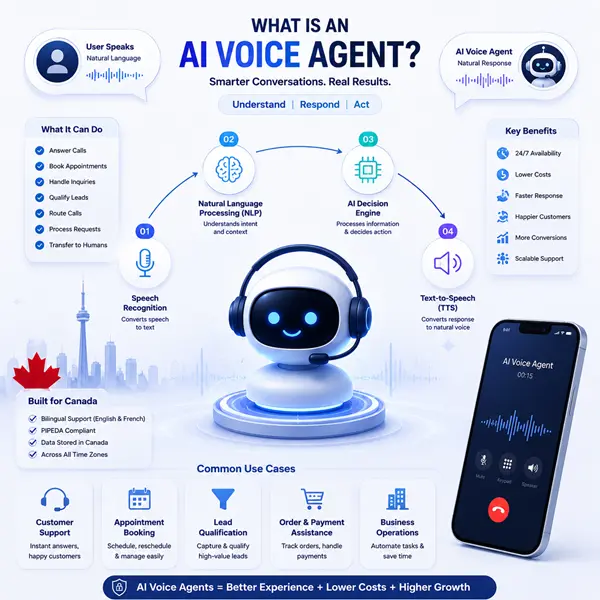
Most AI voice systems work using four main technologies.
Speech Recognition (ASR)
Automatic Speech Recognition converts spoken words into text.
The AI “hears” the customer and transforms audio into readable data.
Natural Language Processing (NLP)
Natural Language Processing helps the system understand meaning and intent.
For example:
- “I need help with my bill”
- “There’s a problem with my payment”
- “Why was I charged twice?”
All may point to the same issue.
The AI identifies the intent behind the words instead of relying on exact phrases.
AI Decision Engine
This is the “brain” of the voice agent.
It decides:
- What the customer wants
- What action to take
- What response should come next
Modern AI voice systems often use large language models to generate more natural conversations.
Text-to-Speech (TTS)
Finally, the AI converts text responses back into natural-sounding speech.
Today’s AI voices sound significantly more human than older robotic systems. Tone, pacing, and pronunciation have improved dramatically in recent years.
How AI Voice Agents Work
AI voice agents operate through a step-by-step process that allows them to communicate naturally with users.
Step 1: Listening to the User
The system captures the user’s voice input through a phone call or device microphone.
Step 2: Understanding the Request
The AI processes the spoken words and identifies the customer’s intent.
Step 3: Processing Information
The system checks connected databases, calendars, CRMs, or workflows to complete the request.
Step 4: Responding Naturally
The AI generates a human-like voice response in real time.
This entire process happens within seconds, creating smooth and natural conversations.
AI Voice Agents vs Traditional IVR Systems
Many people confuse AI voice agents with traditional IVR systems, but there is a significant difference between the two.
Traditional IVR Systems
Older IVR systems are menu-based and rigid.
Examples include:
- “Press 1 for sales”
- “Press 2 for support”
These systems:
- Follow fixed scripts
- Cannot understand natural conversation
- Often frustrate users
- Provide limited flexibility
AI Voice Agents
AI voice agents are conversational and dynamic.
Instead of pressing buttons, users can simply speak naturally.
For example:
- “I want to change my delivery address.”
The AI understands the request immediately and responds accordingly.
This creates a much smoother and more human customer experience.
Conversational AI Basics
Conversational AI refers to technologies that allow machines to communicate naturally with humans.
AI voice agents are one of the most advanced forms of conversational AI because they involve real-time speech interactions.
Key Features of Conversational AI
- Context awareness
- Natural responses
- Multi-turn conversations
- Intent recognition
- Real-time understanding
- Human-like interaction
Unlike simple chatbots, conversational AI systems can maintain conversation flow and adapt dynamically based on what users say.
Common Uses of AI Voice Agents
AI voice agents are now being used across many industries in Canada and globally.
Customer Support
Businesses use voice AI to:
- Answer common questions
- Provide order updates
- Handle account inquiries
- Troubleshoot basic issues
This reduces waiting times and improves customer satisfaction.
Appointment Booking
Clinics, salons, and service businesses use AI voice systems to:
- Schedule appointments
- Confirm bookings
- Send reminders
- Handle cancellations
Appointment booking remains one of the strongest real-world use cases for voice AI.
Lead Qualification
AI voice agents can:
- Answer inbound sales calls
- Ask qualification questions
- Collect customer information
- Route hot leads to sales teams
This helps businesses respond faster to potential customers.
After-Hours Support
Many businesses miss leads because nobody answers calls outside office hours.
AI voice agents can operate 24/7, ensuring businesses never miss opportunities.
Healthcare Industry
Healthcare organizations use voice AI for:
- Patient intake
- Appointment reminders
- Prescription refill requests
- Basic symptom screening
However, sensitive medical cases still require human involvement in most situations.
Banking and Finance
Banks and financial institutions use AI voice technology for:
- Account verification
- Transaction support
- Fraud alerts
- Customer assistance
Security and compliance are extremely important in these industries.
Benefits of AI Voice Agents
The rapid growth of voice AI is happening for a reason. Businesses see major advantages when implemented correctly.
24/7 Availability
- AI voice agents never sleep.
- Businesses can answer calls anytime, including weekends and holidays.
Faster Response Times
- Customers receive instant assistance without long hold times.
- This significantly improves customer experience.
Cost Efficiency
- Voice AI can handle high call volumes at lower operational costs compared to large support teams.
Scalability
- During busy periods, AI systems can manage thousands of conversations simultaneously.
- Human teams alone cannot scale this quickly.
Consistency
- AI voice agents provide consistent responses and follow workflows accurately.
Better Lead Capture
- Businesses lose many leads due to missed calls.
- Voice AI helps capture inquiries immediately.
Multilingual Support
- Modern systems can communicate in multiple languages, helping businesses serve diverse audiences across Canada.
Challenges and Limitations of Voice AI
Despite major improvements, AI voice agents are not perfect.
There are still limitations businesses need to understand before implementation.
Complex Conversations
- AI performs best with structured or repetitive tasks.
- Highly emotional or complicated conversations may still require human agents.
Background Noise and Accents
- Poor audio quality or strong accents can sometimes reduce accuracy.
Latency Issues
- Even small delays can make conversations feel unnatural.
- Fast response speed is critical for good user experience.
Poor Workflow Design
- Many businesses fail because they focus only on voice quality rather than conversation design.
- Without proper structure and integrations, AI conversations become confusing.
Privacy and Security Concerns
Businesses must ensure:
- Secure data handling
- Consent compliance
- Identity verification
- Regulatory compliance
This is especially important in the healthcare and finance sectors.
AI Voice Agents vs Chatbots
Although both use conversational AI, there are major differences between voice agents and traditional chatbots.
AI Voice Agents
- Communicate through spoken conversations
- Handle phone calls and voice interactions
- Provide more human-like experiences
- Operate in real time
Chatbots
- Mainly communicate through text
- Usually appear on websites or messaging apps
- Depend on typed conversations
- Often handle simpler interactions
Voice interactions usually feel more natural and personal compared to text-based conversations.
What Makes a Good AI Voice Agent?
A high-performing AI voice agent usually includes several important qualities.
- Fast Response Speed
Slow systems frustrate users and damage customer experience.
- Natural Conversation Flow
The AI should sound smooth, conversational, and easy to understand.
- Strong Integrations
Connecting with calendars, CRMs, booking systems, and databases is critical.
- Clear Objectives
The agent should focus on specific tasks rather than trying to handle everything at once.
- Human Handoff
Complex situations should transfer seamlessly to human staff when needed.
In Summary
AI voice agents are transforming how businesses communicate with customers. Unlike old automated systems, modern voice AI can understand natural language, respond conversationally, and complete real tasks in real time.
As conversational AI technology continues improving, AI voice agents are becoming more human-like, efficient, and useful across industries.
While AI voice agents still have limitations, their capabilities are evolving rapidly. Businesses that understand how to use them strategically today may gain a major advantage in the years ahead.
Frequently Asked Questions
Q1. How does an AI voice agent work?
It works using speech recognition, natural language processing, machine learning, and text-to-speech technology to understand spoken language and respond conversationally.
Q2. Are AI voice agents the same as chatbots?
No. Chatbots mainly communicate through text, while AI voice agents interact using spoken conversations over phone calls or voice-enabled devices.
Q3. What industries use AI voice agents?
Industries using AI voice agents include healthcare, banking, customer support, real estate, restaurants, automotive services, and e-commerce.
Q4. Can AI voice agents replace human employees?
AI voice agents can automate repetitive tasks, but human employees are still needed for complex conversations, emotional situations, and advanced decision-making.