AI automation has moved from being a “nice-to-have” experiment to a core operational strategy for many Canadian businesses. Whether it’s a dental clinic in Toronto, a logistics company in Calgary, or a SaaS startup in Vancouver, the same question keeps coming up: what is the real ROI of AI automation in Canada?
In simple terms, AI automation ROI Canada refers to the measurable value businesses gain from using artificial intelligence to reduce costs, increase revenue, and improve efficiency. But unlike generic global discussions, Canada has its own economic and regulatory conditions that significantly influence ROI outcomes.
- High labour costs
- Strong small and medium-sized business ecosystem
- Bilingual customer expectations
- Strict privacy regulations under PIPEDA
All of these shape how AI delivers value.
Because of this, AI ROI in Canada is not just about saving time. It is about recovering lost revenue, improving compliance, and creating scalable operations in a high-cost labor environment.
Why AI Automation ROI is Different in Canada
AI automation delivers value everywhere, but in Canada the impact is more financially visible and operationally urgent.
Labour cost structure
- Hiring staff in major Canadian cities like Toronto or Vancouver is expensive
- High costs apply especially to:
-
- Customer support roles
- Admin work
- Sales coordination
- This makes automation savings significantly more impactful compared to lower-cost economies
Strong reliance on SMEs (Small and Medium-Sized Businesses)
- Many Canadian businesses operate with lean teams
- Limited headcount increases dependency on efficiency tools
- A single AI system can:
- Handle calls
- Manage chats
- Automate scheduling
- Qualify leads
- This reduces the need for multiple manual workflows
- No major organizational restructuring required
Regulatory environment (PIPEDA)
- PIPEDA compliance plays a major role in customer data handling
- AI systems must ensure:
- Proper data handling
- Secure storage
- Clear consent management
- Adds a compliance layer into ROI calculations
- Avoiding regulatory risk becomes a financial advantage in itself
Customer expectations and response speed
- Canadian customers expect fast response times
- Delays or missed calls often result in lost customers
- If a business:
- Misses a call
- Responds too slowly
- Customers usually switch to competitors
- This makes missed-call recovery one of the strongest ROI drivers in Canada
What AI Automation ROI Actually Includes
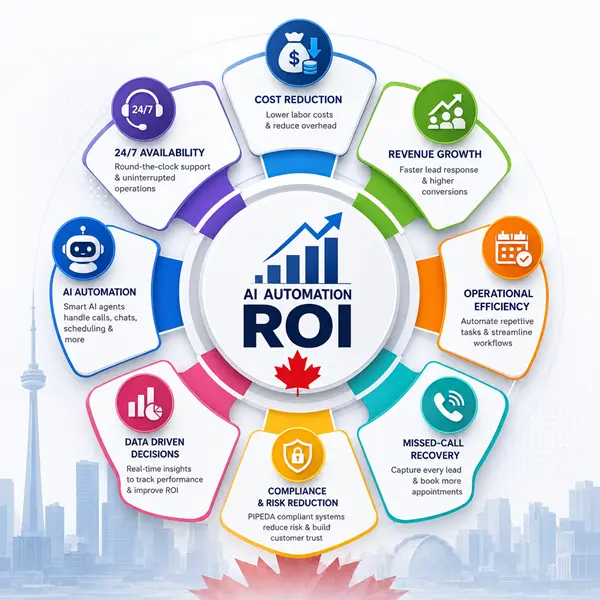
Many businesses underestimate AI ROI because they focus only on labor savings. In reality, AI automation ROI in Canada is multi-dimensional.
Direct cost savings
- Reducing need for customer support staff
- Cutting administrative workload
- Minimizing overtime hours
- Significant annual savings due to wage levels
Revenue increase
- Faster lead response time
- Higher conversion rates
- Strong impact in real estate, legal, home repair, healthcare
Operational efficiency
- Automating scheduling, invoice follow-ups, FAQ handling
- Internal ticket routing
- Reducing delays and human errors
Missed-call recovery
- Capturing leads outside business hours
- Turning lost opportunities into booked appointments
Compliance and risk reduction
- PIPEDA-aligned systems reduce legal risk
- Avoiding penalties improves long-term ROI
How to Measure AI Automation ROI Step by Step
To properly evaluate AI automation ROI Canada, businesses need a structured approach.
Step 1: Establish baseline costs
- Customer support expenses
- Admin costs
- Lead handling costs
- Operational overhead
Step 2: Identify automation opportunities
- Repetitive tasks
- Call answering
- Email responses
- Lead qualification
- Appointment scheduling
Step 3: Estimate time savings
- Measure hours reduced
- Convert into salary/productivity savings
Step 4: Measure revenue impact
- Faster response times
- Improved conversions
- 24/7 availability
Step 5: Factor in implementation costs
- AI subscriptions
- Setup costs
- Integration expenses
- Training
Final step: Calculate ROI
Compare total benefits vs total costs over 6–12 months.
AI Adoption in Canada: Where Businesses Are Getting ROI First
AI adoption in Canada is accelerating, but ROI is not evenly distributed across industries.
- Service-based businesses (home services, plumbing, HVAC, cleaning, dental clinics)
- E-commerce (chat automation, abandoned cart recovery)
- B2B SaaS (lead qualification, onboarding, customer success)
- Healthcare clinics (appointments, patient communication)
Common pattern: businesses relying on inbound leads see fastest ROI.
Missed-Call Recovery: The Hidden ROI Engine in Canada
One of the most overlooked contributors to AI automation ROI in Canada is missed-call recovery.
In many industries, especially home services and healthcare, a missed call often equals a lost customer. Customers rarely call back if they don’t get a response quickly.
AI voice agents and automated systems can:
- Capture lead information
- Book appointments
- Route urgent calls
- Send follow-ups
Even small improvements in response rates can significantly increase monthly revenue.
PIPEDA and AI Compliance Considerations
AI automation in Canada must operate within PIPEDA regulations.
Businesses must ensure:
- Transparent data usage
- Customer consent management
- Secure storage systems
- Limited access to sensitive data
Compliance is not just a legal requirement — it improves ROI by reducing risk and increasing customer trust.
Typical AI ROI Timeline in Canadian Businesses
Most Canadian businesses see measurable results within 30 to 90 days.
- Simple automation (chatbots, scheduling): 1 month ROI
- Complex workflows: 3 to 6 months
Key factor: speed of adoption.
Common Mistakes Businesses Make When Calculating AI ROI
- Only measuring cost savings, ignoring revenue gains
- Ignoring missed-call revenue recovery
- Underestimating implementation costs
- Overestimating immediate adoption speed
- Ignoring PIPEDA compliance costs
Future of AI Automation ROI in Canada
The future is moving toward full operational integration rather than isolated tools.
Instead of single-task automation, businesses are building connected AI workflows across:
- Customer support
- Sales
- Marketing
- Operations
ROI will shift from cost savings to revenue acceleration and experience optimization.
Early adopters will gain a strong competitive advantage.
Frequently Asked Questions
Q1. What is a good AI automation ROI for Canadian businesses?
A strong ROI typically ranges from 3x to 10x within the first year, depending on industry and implementation depth.
Q2. How long does it take to see ROI from AI in Canada?
Most businesses see initial ROI within 30 to 90 days, with full optimization in up to 6 months.
Q3. Is AI automation worth it for small businesses in Canada?
Yes. SMBs often benefit the most because AI replaces multiple manual roles without large hiring costs.
Q4. Does AI help with missed calls and lost leads?
Yes. AI systems can capture leads, respond instantly, and book appointments automatically.
Q5. Is AI compliance required under PIPEDA?
Yes. Any system handling personal data must comply with PIPEDA rules.
Q6. What industries benefit most from AI ROI?
Home services, healthcare, real estate, SaaS, and e-commerce.
Q7. What is the biggest hidden ROI factor in AI automation?
Missed-call recovery is often the biggest hidden driver of ROI.